Helluva Boss OC Maker

This Helluva Boss OC Maker turns an original imp or hellhound concept into a full-body illustration, a front-side-back turnaround or a widescreen story scene.

HEIC, JPEG, PNG or WebP · Up to 40 MB

Character design
Extra details
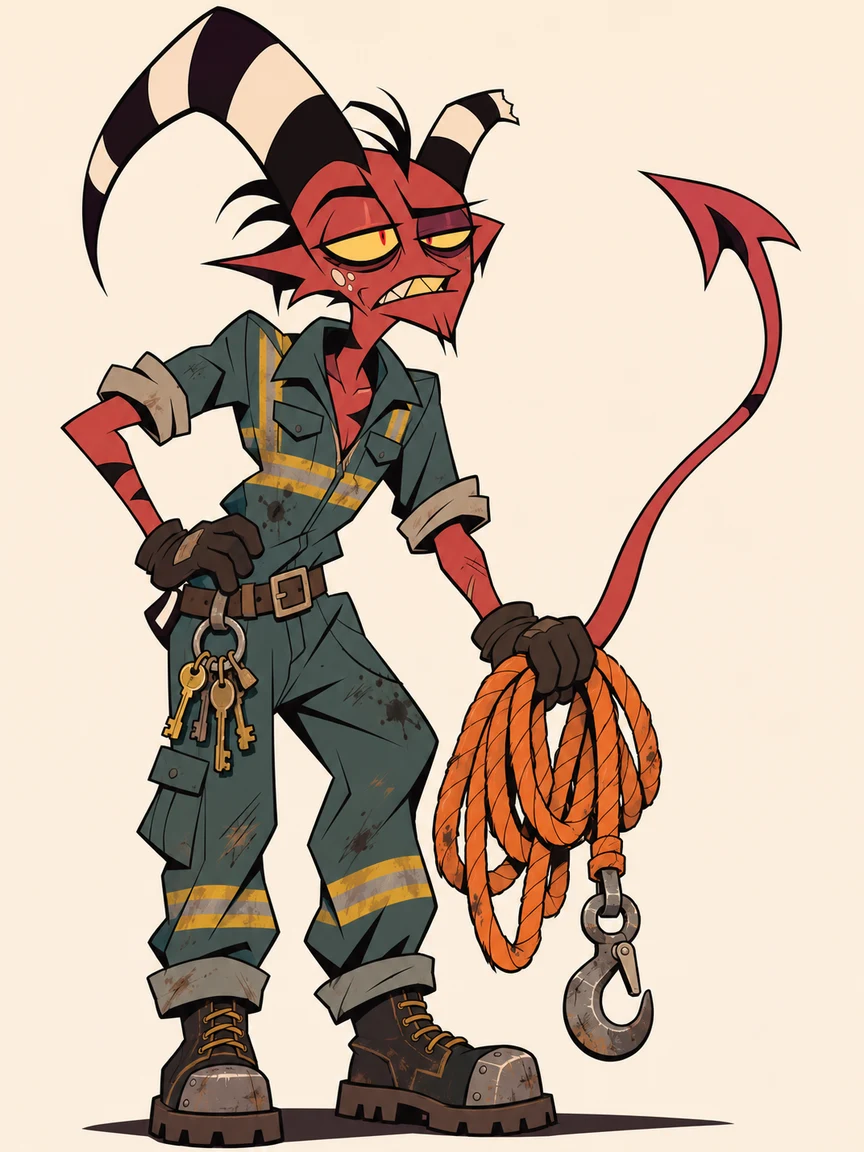
Red imp tow mechanic in teal coveralls holding an orange coil of rope
Composition example · Full-body character

Make a Helluva Boss OC that reads at a glance

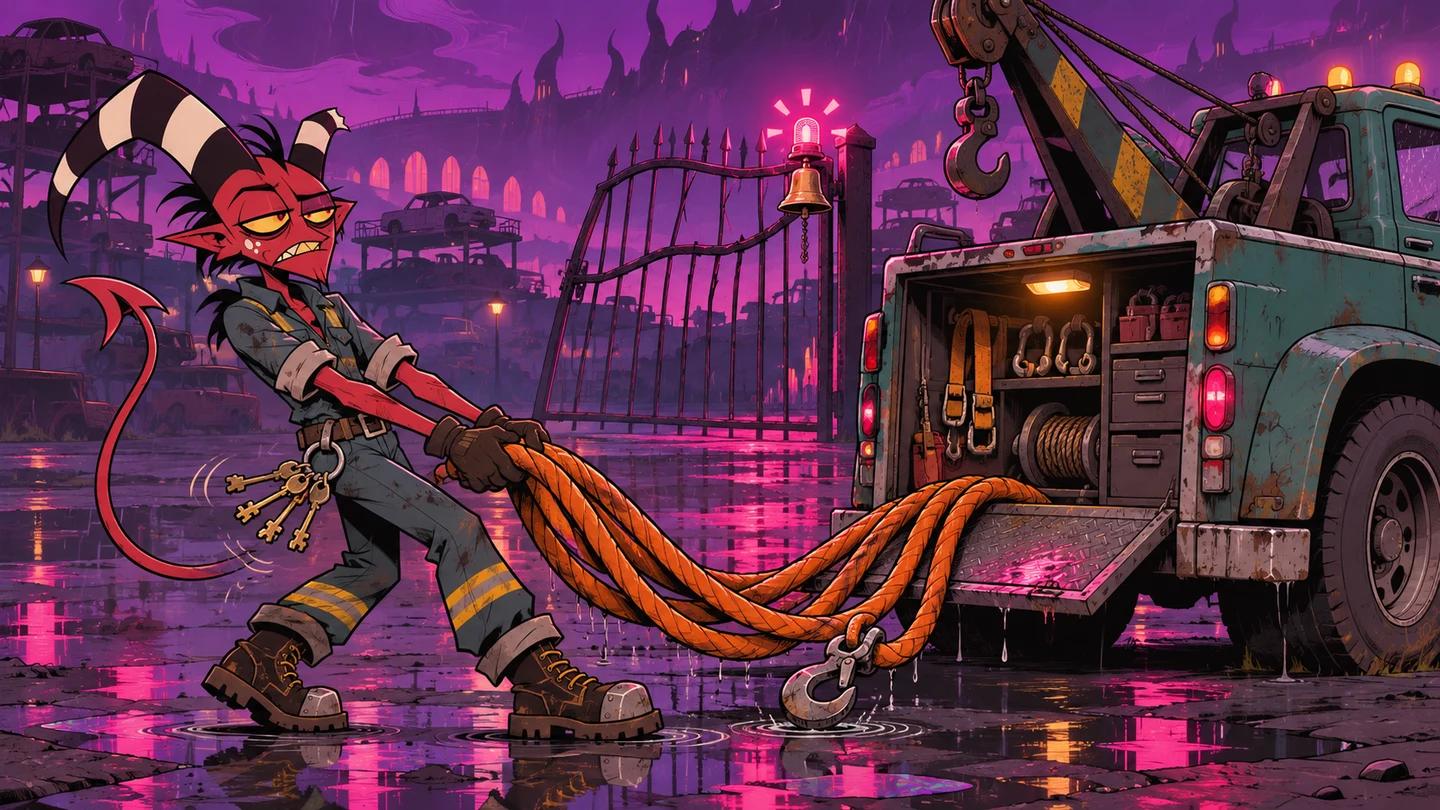
Start with the shape you would recognize across a crowded room. Rivet’s chipped horn, hooked tail and oversized coil of rope each pull the eye in a different direction, while the sloping shoulders make the character look like someone who has been hauling equipment all night. Try sketching or imagining the whole design in one solid color. If the costume and gear dissolve into the body, move one prop away from the waist or give the head a shape that contrasts with the shoulders.

Red imp tow mechanic in teal coveralls holding an orange coil of rope

Rivet, night-shift tow mechanic

Use thick black outlines to establish the figure and thinner interior lines for the details that belong up close, such as a boot seam or the fold in a work glove. Flat colors make the face and costume easy to follow when the pose gets exaggerated. An oversized head can make a sidelong look read immediately, while long limbs can give a runner a gangly stride. Give each proportion a reason that connects it to the character’s mood or job.

Try a palette that suggests the part of Hell your character works in. Teal coveralls separate Rivet from a purple night sky, and an orange rope stands out against both. A corner diner could use cherry red and warm cream, while a night courier might carry a bright yellow satchel against a cool charcoal coat. Two main colors and one small accent leave room for the expression to carry the picture.

Shape an imp or a hellhound

An imp concept can start with short horns and a tail that you can read against the background. Try mismatched horn tips or a low, backward curve to keep the outline compact. A tail can echo the pose. A pointed bend makes a startled dispatcher look suddenly alert, while a relaxed sweep can soften a mechanic who keeps a steady pace. In a turnaround, choose where the tail sits behind the clothing so its base still makes sense from the side and back.

A hellhound design starts with the ears and muzzle. Tall ears can make a narrow head read at a distance. One folded ear and a broad muzzle give a similar body a different profile. Use a fur marking that follows the form, such as a pale cheek stripe that narrows as it approaches the nose. Keep the markings specific enough to describe where they belong when you turn the character around.

I.M.P. is a company in the series. If you want your original character to have a connection to it, treat that as part of their employment or story. An imp who repairs a company van and a hellhound who delivers signed paperwork can share a workplace while having different silhouettes, personalities and reasons for doing the job.

For another Hellaverse-inspired character, explore costumes and theatrical powers in the Hazbin Hotel OC Maker.

Give the job a prop people remember

Use the Occupation field for a job you can show in a single frame. “Building super” suggests keys, gloves and a belt that gets caught on door handles. “Night-shift cook” suggests an apron with an oversized pocket and sleeves rolled to a consistent height. Write one detail about how the job changes the outfit. A coiled headset cable belongs somewhere different on a dispatcher’s jacket than the spare battery of a roadside technician.

The imp mechanic pulls a recovery rope beside a tow truck in a rain-soaked yard

Story scene

Put the most visible object in Signature prop. Give it a distinctive shape, a material and an obvious place to carry it. A copper hose nozzle clipped to one hip reads differently from a smooth ceramic meter dangling from a wrist. You can carry that one prop through all three compositions. In the full-body design it establishes the job, in the turnaround it shows how it attaches, and in the story scene it gives the character something to do.

Use Pose and expression to connect the character to the object. Ask a hurried courier to cradle a battered satchel with one elbow while checking a street sign. Ask a tired repair imp to brace a wrench against one shoulder and glance at a stubborn bolt. The expression has more to say when the hands are already busy.

Invent an ability with a visible cost

An original ability gives the character a problem to solve in the story scene. Decide what the ability does, what the viewer can see when it works, and what stops it from solving every problem. A mechanic’s rope could briefly become rigid enough to bridge a gap, but every use could fray the end that holds the hook. That makes the orange rope part of the action and gives a second character a reason to look worried.

Give the limit an object or gesture the artist can draw. A hellhound courier might hear an echo of the last person who touched a package, but only while holding the package against a bare ear. A locksmith might see the last position of a key by warming a lock, then need to wait for it to cool. These are optional fan-character abilities you can adapt to the scene.

Add the ability and its limit under Extra details. For a story scene, use Story setting and action to show the instant when both matter. A sign painter can make an arrow detach from the board for ten seconds. Put the painter halfway up a ladder with one hand still on the brush and a falling toolbox behind them. The picture can show the trick and its consequence at the same time.

10 Helluva Boss OC ideas you can build

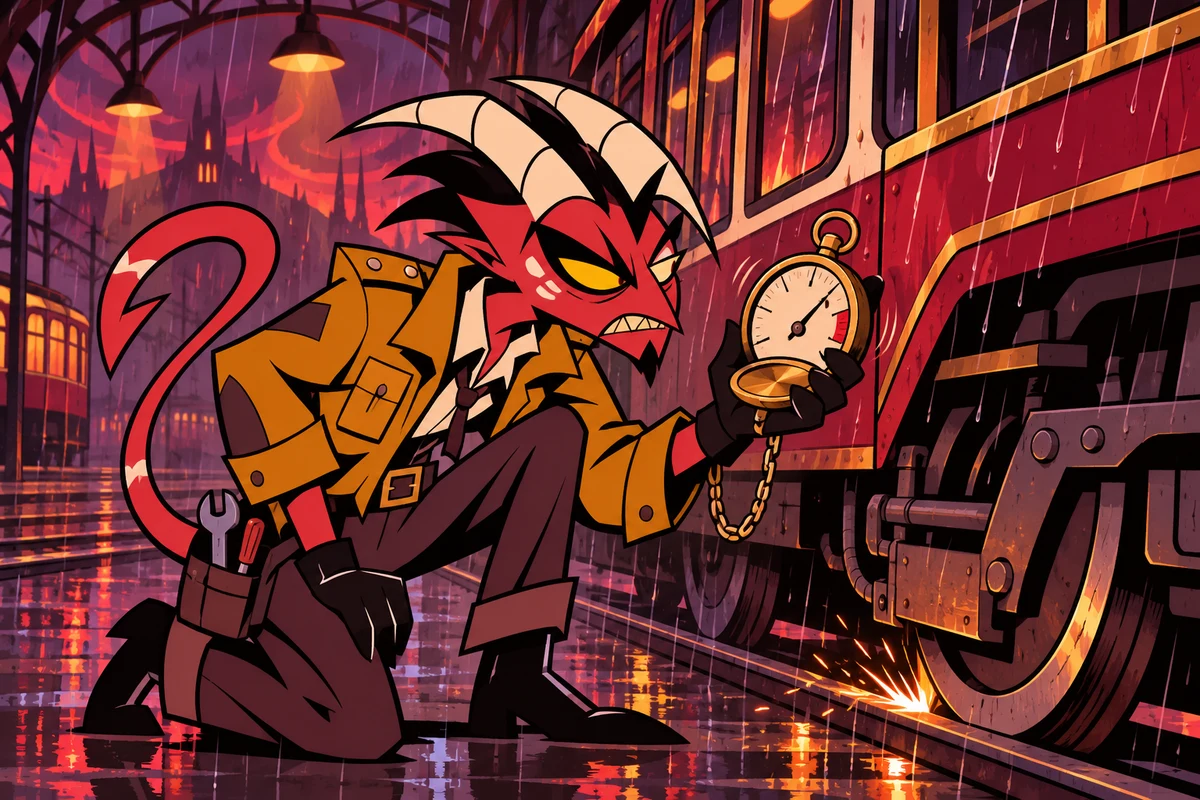
Pico Brake kneels beside a tram in the rain while reading a brass brake gauge

Pico Brake

An imp brake inspector with low, forward-leaning ivory horns and a red tail bent like a question mark. Give Pico a boxy mustard jacket and a brass brake gauge shaped like a pocket watch. In a story scene, Pico kneels beside a tram in a rain-streaked depot, watching the needle wobble as a train of sparks lights the tunnel.
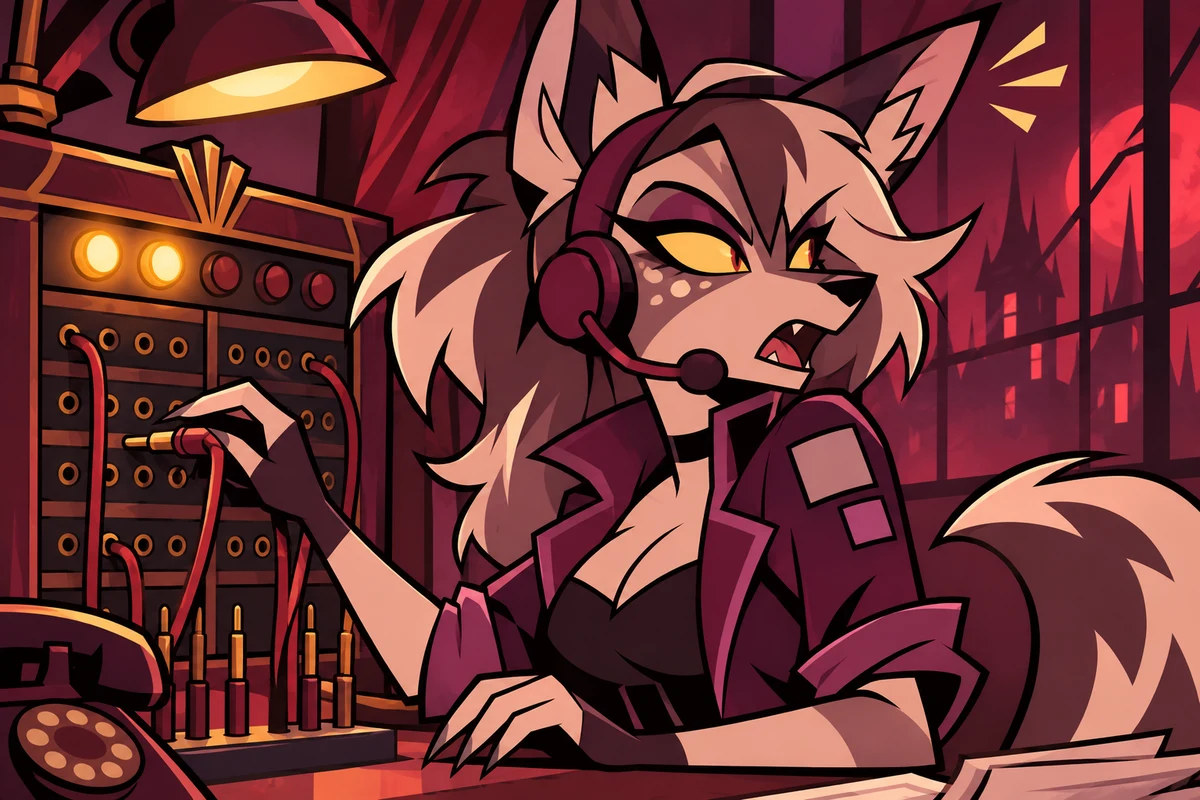
Tamsin Bell wears a plum headset as she reaches for the lit switchboard

Tamsin Bell

A hellhound late-night dispatcher with upright ears, a broad muzzle and pale flecks above one eye. A plum headset and a square patch on her jacket establish the job in a front view. Set her at a switchboard when two lines light up at once, with one ear turned toward a sound the callers cannot hear.

Cinder Wick

An imp streetlamp technician with blunt charcoal horns, a loose tail and a rust-red climbing harness. Cinder keeps spare lamp filaments in a clear tube clipped across the chest. Give the scene one strong pool of light beneath a repaired lamp, with Cinder still hanging halfway up the pole above it.

Moxie Spindle

A hellhound upholstery repairer with a narrow muzzle, dark russet fur and one folded ear. A cobalt apron carries a curved needle as long as a forearm. Show her balancing on the back of a torn sofa while feeding a green thread through its seam, her ears tilted toward a noise inside the cushions.

Kettle Knell

An imp canteen cook with short spiral horns and a tail tipped like a tiny ladle. A faded cream cap and broad oven mitts give Kettle a soft silhouette with room for an impatient glare. In the story scene, use a copper steam valve as the signature prop and show Kettle guiding a plume away from the serving hatch.

Juno Parcel

A hellhound courier with brindled calves, a white chin and two pointed ears that poke through a sleeveless raincoat. Juno’s satchel has a single oversized clasp and a crescent-shaped water stain. Draw the satchel swinging forward as Juno slides to a stop outside a shuttered delivery entrance.

Flint Tally

An imp salvage clerk whose tiny wedge-shaped horns frame an oversized set of round safety glasses. A wooden tally board hangs from a dusty teal vest. Flint can sense a misplaced piece only while the tally board is full, so show the clerk removing the last peg just as a pile of hardware starts to slide.

Bramble Meter

A broad-muzzled hellhound water-meter reader with a cream stripe down the nose and two ears that fold in different directions. A compact red rubber coat leaves the shoulder markings readable. Put Bramble at the edge of an alley drain holding a ceramic gauge, trying to decide whether the sound below is a pipe or a voice.

Vika Rivetline

An imp theater rigger with short black horns and a long tail that curls under a safety belt. A mint carabiner and a stack of folded cue cards define the silhouette. Give Vika one foot on a catwalk and the other hooked around a rung while an unfinished painted backdrop rises behind her.

Slate Taper

A lean hellhound sign painter with silver fur around the eyes, a tapered muzzle and a paint-stained orange cuff. The signature prop is a three-bristle brush in a flat wooden case. Slate can pull one painted arrow off its board for ten seconds, so show the arrow pointing away from an overturned paint pail.

Turn your character into three views or a story scene

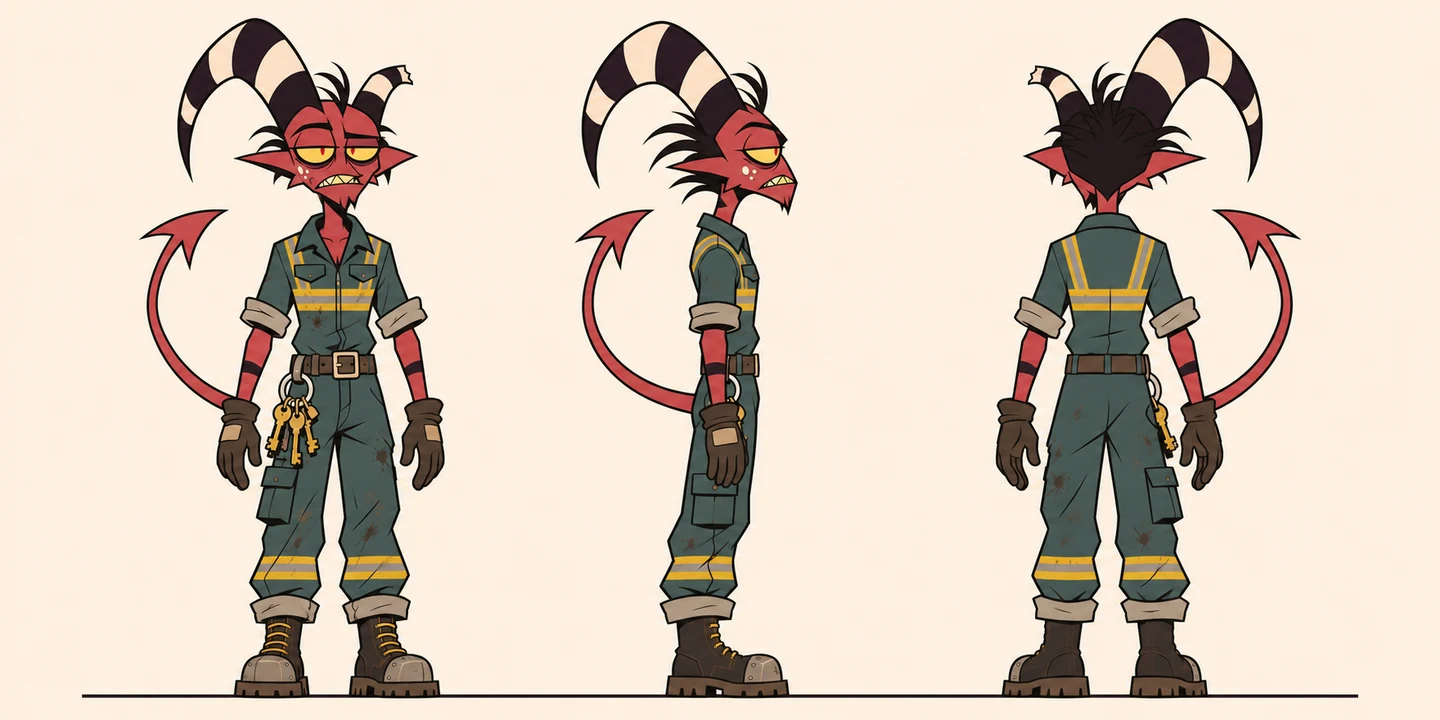
A full-body illustration helps you settle the character’s outline and colors. Choose that composition first if you are still deciding how the horns curve, where the prop hangs, or how much of the tail clears the coat. Once the design is usable, carry those choices into Front, side and back. Use the same clothing and markings and mention which side holds the prop. A clean background and a shared ground line make the three views easier to compare.

Three aligned views of the imp mechanic showing horns, tail and workwear

Front, side and back

If your model accepts an image reference, upload your original artwork or a previous illustration to guide the turnaround. Describe anything the reference cannot show, such as a back pocket, the base of the tail or where the cuff ends under a glove. Keep pose instructions simple for this view and use Pose and expression to retain the character’s attitude. Save the profile for checking the muzzle or nose and the rear view for any straps or fasteners.

Choose Story scene when you want to see the prop in use. Name the setting and the action that happens in the frame. Rivet’s coil becomes a stretched recovery line at the salvage yard, which makes the tow job clear before anyone reads a character bio. Once you have chosen your composition and filled in the relevant fields, check the model and credit quote in the Builder, then sign in and generate the illustration.

Return to the character Builder

Helluva Boss character maker FAQ

Can I make an imp or a hellhound OC?

Yes. Edit horns and a spade tail for an imp, or choose fur markings, ears and a muzzle for a hellhound. Both designs have editable workwear, a job and a signature prop.

Can I use my own character artwork?

Yes. With a reference-capable model, upload your artwork to guide the character’s identity, proportions and costume in another composition.

What does the turnaround include?

The prompt requests a full-body front, side and back view with the same outfit and scale across the sheet.

Does it cost credits?

The editor displays the credit quote next to the generate button. Check it after choosing a model, since the cost depends on the model you select.

Can I make a Helluva Boss OC for free?

You can explore the examples, load a concept and edit your character brief for free. Generating an illustration requires an account and uses the credits shown for your selected model.

Can my OC be a species other than an imp or a hellhound?

The species controls cover imps and hellhounds. For another species, try the general Anime Character Creator, which takes a written description of your original character.

What art style should I ask for?

Start with bold black contours, flat color, angular shapes and an expressive face. Use Extra details to specify a palette, line weight or proportion, such as a large head and narrow shoulders.

Is this an official Helluva Boss tool?

This is an independent fan tool for original characters. It is unaffiliated with Helluva Boss, its creators or SpindleHorse.

Helluva Boss was created by Vivienne Medrano. This independent fan tool is not affiliated with or endorsed by Vivienne Medrano, SpindleHorse, A24 or Amazon. It uses no official artwork or canonical character designs.