Apothecary Diaries OC Maker

This Apothecary Diaries OC maker turns an original palace servant, doctor or consort into a full-body illustration, a turnaround or a story scene.

HEIC, JPEG, PNG or WebP · Up to 40 MB

Character design
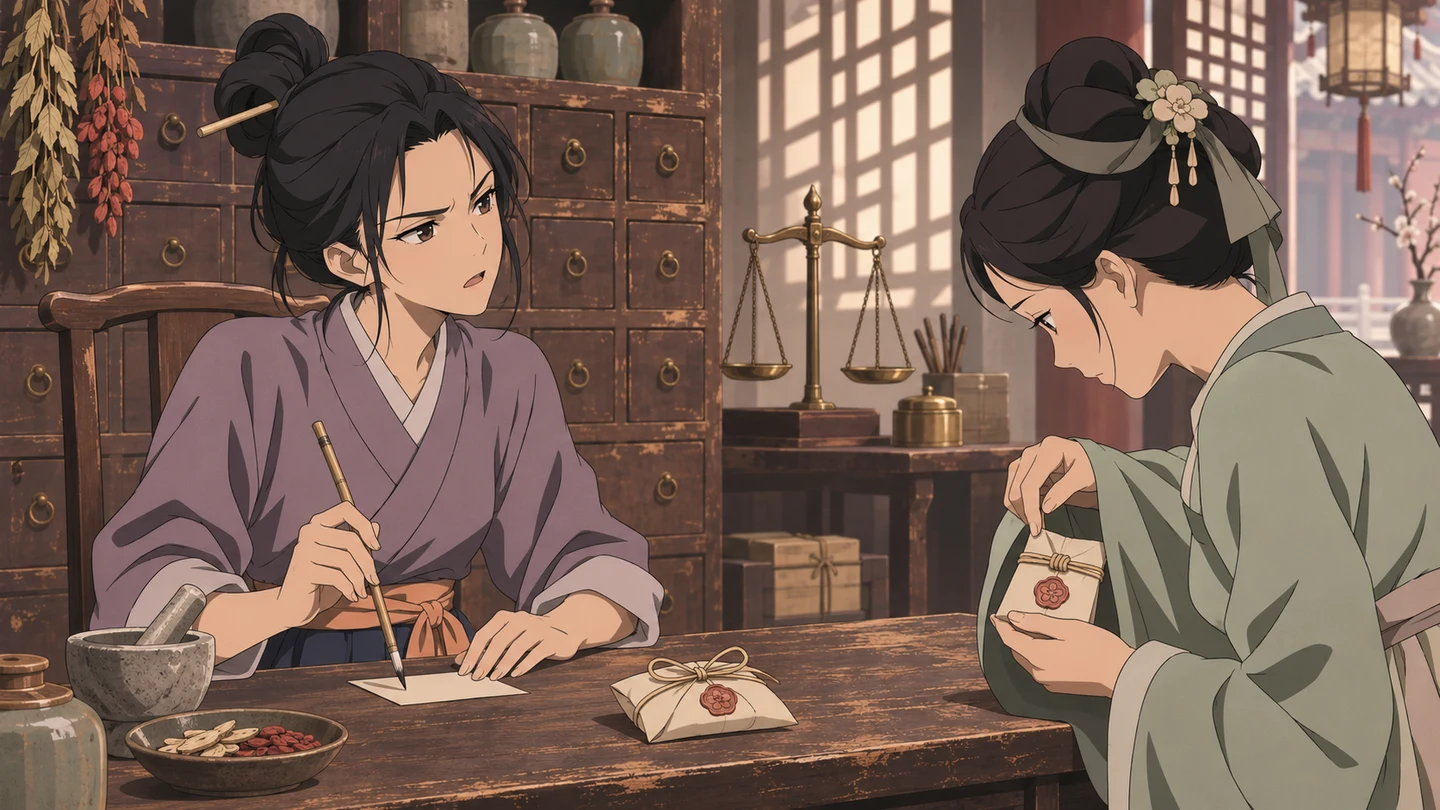
Minglan holds a writing brush at her apothecary desk while a patient shows her a plum-sealed medicine packet
Composition example · Story scene

Make an apothecary diaries oc that belongs in the rear palace

Minglan holds a writing brush at her apothecary desk while a patient shows her a plum-sealed medicine packet

Story scene

Minglan, a palace apothecary, asks a maid about her last visit, her brush poised over the prescription paper. The packets on the desk bear the same plum-blossom seal, but the cords are tied differently.

Give your own character a job, an object they handle every day and a detail only they would notice. Start with the role and trade in the palace builder.

How the palace works, and where your OC fits

The Apothecary Diaries OC settings in the rear palace

The first season sets much of Maomao’s story in the rear palace, where consorts live with the people who serve their households. For an original character, that makes a delivery route as interesting as a title. Place the character at a regular station, such as a household storeroom, and give them one reason to leave it. The gate, the path and the person waiting at the far end can do much of the work of establishing the setting.

The four consorts and their palaces

Season one identifies Gyokuyou with the Jade Pavilion, Lihua with the Crystal Pavilion, Lishu with the Diamond Pavilion and Ah-Duo with the Garnet Pavilion at the start of the story. Decide what an established household needs from your character. A Jade Pavilion attendant might know how to fold and deliver a personal note. A worker sent to the Crystal Pavilion might recognize its steward through repeat orders. Leave the household’s place in the court intact and invent a small duty within it.

Palace servants and personal attendants

Service work gives you a choice of proximity. A worker who collects linens meets several households in the course of a morning, while a personal attendant learns the habits of a few people intimately. Use that difference to set costume and posture. A linen worker can carry a balanced bundle in both arms. An attendant ready to receive an instruction can keep her hands free and carry a folded cloth tucked at the waist.

Eunuchs and physicians

Eunuchs are part of the rear palace’s staff and administration. You could invent a messenger familiar with each doorway or a keeper who handles registers and repairs. The series also depicts a physician serving the rear palace. For a physician or apothecary concept, give the character an everyday task that can be drawn clearly, such as comparing two handwritten records or sorting labeled packets. Their scene can turn on observation, responsibility or the choice to ask for help.

The inner and outer court

The rear palace and the outer court offer different kinds of access. Station a clerk, workshop hand or supplier at an authorized handover and give the person on the other side a job of their own. The resulting exchange makes a useful boundary for character writing. Your supplier can know every mark on a box and still have to ask where it goes next. The season-one terminology comes from the official first-season keyword guide.

Three routes: servant, doctor, consort

Paste a starting prompt into Prompt mode in the palace builder, or use its details to fill in the Builder fields. Each design gives the artist a full silhouette, a working palette and an object the character has a reason to hold.

Servant bringing linens to a pavilion

Original palace linen attendant, head-to-toe portrait, smoke-blue cross-collar jacket with cream wrist ties, ochre work skirt and gray cloth sash, plain dark shoes, low bun secured with a wooden pin, both hands balancing a tidy bundle with a stitched household mark on the fold, one foot planted at the threshold of a covered walkway, restrained period anime linework and morning light.

Palace apothecary between appointments

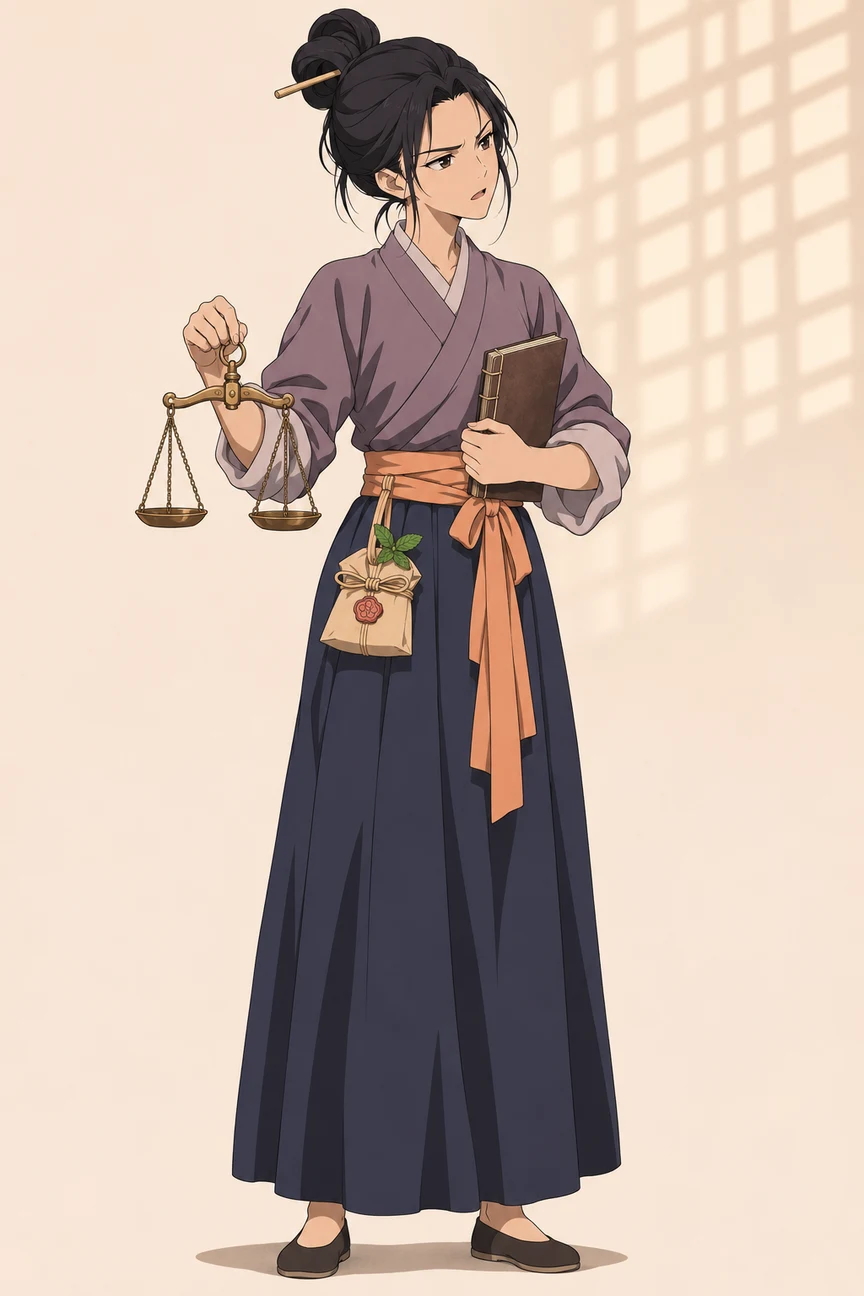
Original palace apothecary, full-length portrait, pale lilac-gray cross-collar top with sleeves tied clear of her hands, ink-blue skirt and apricot sash, hair pinned in a low bun, consultation ledger held close and a medicine pouch and small balance visible next to her, warm window light, relaxed stance and an attentive expression as the next patient arrives.

Consort who paints the garden

Original palace consort with a pale peach silk outer robe, moss-green lining visible at the hem, long sleeves with small embroidered reed motifs, high pinned hair with a single wing-shaped ornament, painted fan held low enough to show the sash, dark slippers at the edge of a shaded garden pavilion, graceful full-length silhouette and soft reflected light from a pool.

Give your OC a trade and a signature herb

A trade gives your pose something to do. A paper inspector spreads her fingers to keep a thin sheet flat. A sandal mender braces the work against a knee. A lantern maker holds a frame where the curve can be seen against a bright wall. Write a verb after the job title and put that action in the illustration. When the hands need to be visible, tie back the working sleeves or give them a cut that leaves room at the wrist.

A signature herb can be a sensory detail, a token from home or a motif repeated on a small accessory. An apothecary might carry a sprig of mint in a cloth pouch as a keepsake from home. A garden worker could press a blade of lemongrass between blank pages to remember a particular morning. A consort might ask for a cluster of chrysanthemum leaves to appear on the lining of a fan case. Make the object small enough that it feels like a habit. If the image has to show the plant, specify where it sits and which part is visible.

Pick one surface that shows the character’s daily work. A thumb-polished awl handle suggests years of use. A sash with a slight crease at the same spot suggests a packet is always tucked there. Those marks add a past to a clean full-body design and give you concrete details to carry into a second illustration.

A secret worth hiding

Start with something your character knows because of the job. A dyer recognizes a ribbon’s color under two different lamps. A pond gardener spots a missing ornament from the gap in its reflection. Minglan handles sealed medicine packets each day, which makes a different knot worth noticing. The character’s skill earns that discovery, and their next choice tells you something about them.

Write the scene around the moment a second person could find out. Minglan can set down her brush and ask the maid where the packet came from. The scene leaves room for the maid to explain who tied it or for Minglan to compare the seal with her own. A question about an ordinary packet can change who is trusted with the next order.

10 apothecary diaries oc ideas you can build

Borrow the job, costume and small dilemma as a set, or pick the piece that makes you want to draw. Give anyone you borrow a habit of their own before you build the scene.

Minglan, the palace apothecary — palace consultation story ideas

Minglan sees patients at a desk framed by drawers and a lattice window. She wears a pale lilac-gray top, ink-blue skirt and apricot sash, with a consultation ledger, a medicine pouch and a small balance within reach. She is about to write a prescription when she notices that the medicine packet a palace maid brought bears the same plum-blossom seal as the one on her desk. Only the cords are tied differently. She asks where the packet came from.
Liansu, the sandal mender

Liansu sits beside the service steps with a curved awl, a roll of rush cord and a russet cloth tied over her indigo work skirt. She can identify a regular customer by where the soles wear through. She once stitched a loose courtyard key into a sandal lining for safekeeping. Now the sandals have been collected and she has to ask for them back without explaining why.

Qiaohe, the sound keeper

Qiaohe is a eunuch who maintains the wooden clappers that announce the work shifts. A plum vest, narrow wrist guards and a loop of replacement cords identify him on his rounds. He has been giving one corridor an extra interval at dawn so an elderly attendant can finish her walk before the doors open. An apprentice studying the calls has started counting.

Suyin, the textile dyer

Suyin develops new shades for palace ribbon orders in an outer workshop. A cream apron across a slate-blue robe makes the test swatches at her shoulder easy to see. She keeps a scrap in a shade her late teacher devised. A customer asks for that exact shade, assuming it is her own work, and she must decide whose name belongs on the sample card.

Wenlu, the physician

Wenlu records follow-up observations in a soft brown ledger and marks his place with a gingko-leaf-shaped bookmark. A neatly rolled reed mat takes up most of his faded teal satchel. He struggles to recognize distant faces and has quietly learned to identify colleagues by the sound of their steps. A new ward layout is about to disrupt his routine.

Yanrui, the guest consort

Yanrui keeps a small household and paints garden insects between formal visits. Her pale peach outer robe opens onto a moss-green lining, with a single wing-shaped pendant at the collar. Someone mistakes an unsigned painted cicada for a gift from a far more prominent household. She must decide whether to claim the work before the painting is presented at a gathering.

Shoumei, the lantern frame maker

Shoumei shapes bamboo frames for lanterns with a small curved gauge she wears on a cord. Her short woven sleeve protectors pick up splinters as she works. One unfinished frame has a joint that casts the same scalloped shadow as the lanterns in her childhood home. She had promised her old workshop she would keep its signature pattern private.

Qingbo, the pond gardener

Qingbo wears a reed hat over a muted blue work jacket and carries a shallow tray for the water plants he sorts. At the bottom of the tray rests a clay fish that came from a damaged garden ornament. An apprentice made the fish and hid their initials on its base. Qingbo is saving the piece to return in person after the apprentice is blamed for the break.

Xiaorong, the sleeve embroiderer

Xiaorong works in an attendant’s sewing room with a thumb ring, a folded lap cloth and a set of embroidery cards cut from old wrappers. On her gray sleeve she practices a form of lettering she has only just learned. Her supervisor admires the pattern and asks to put it on a commissioned pouch. The stitched characters spell Xiaorong’s own name.

Luwei, the instrument tuner

Luwei arrives from the outer workshops in a green-gray traveling robe, carrying a padded case of spare bridges. He hums the top note of every scale before setting a bridge. A court musician keeps requesting a tune he recognizes as his mother’s market song. He has been changing one note each time he plays it, hoping the musician will ask where it came from.

Turn the design into a reference sheet or a scene

Establish the signature full-body pose

In Full body view, settle the outer silhouette and the placement of your character’s everyday prop. Describe the cut of the sleeves, where the sash ties and how far the hem falls. Then give the shoulders, feet and hands a task. Use the consultation ledger, medicine pouch and small balance to build Minglan’s pose. Leave space around the balance so its beam and pans read at a glance, and give the ledger a clear edge against her skirt.

Minglan holds a two-pan balance and a consultation ledger, with a mint packet at her apricot sash

Minglan, palace doctor

Keep the outfit consistent across a turnaround

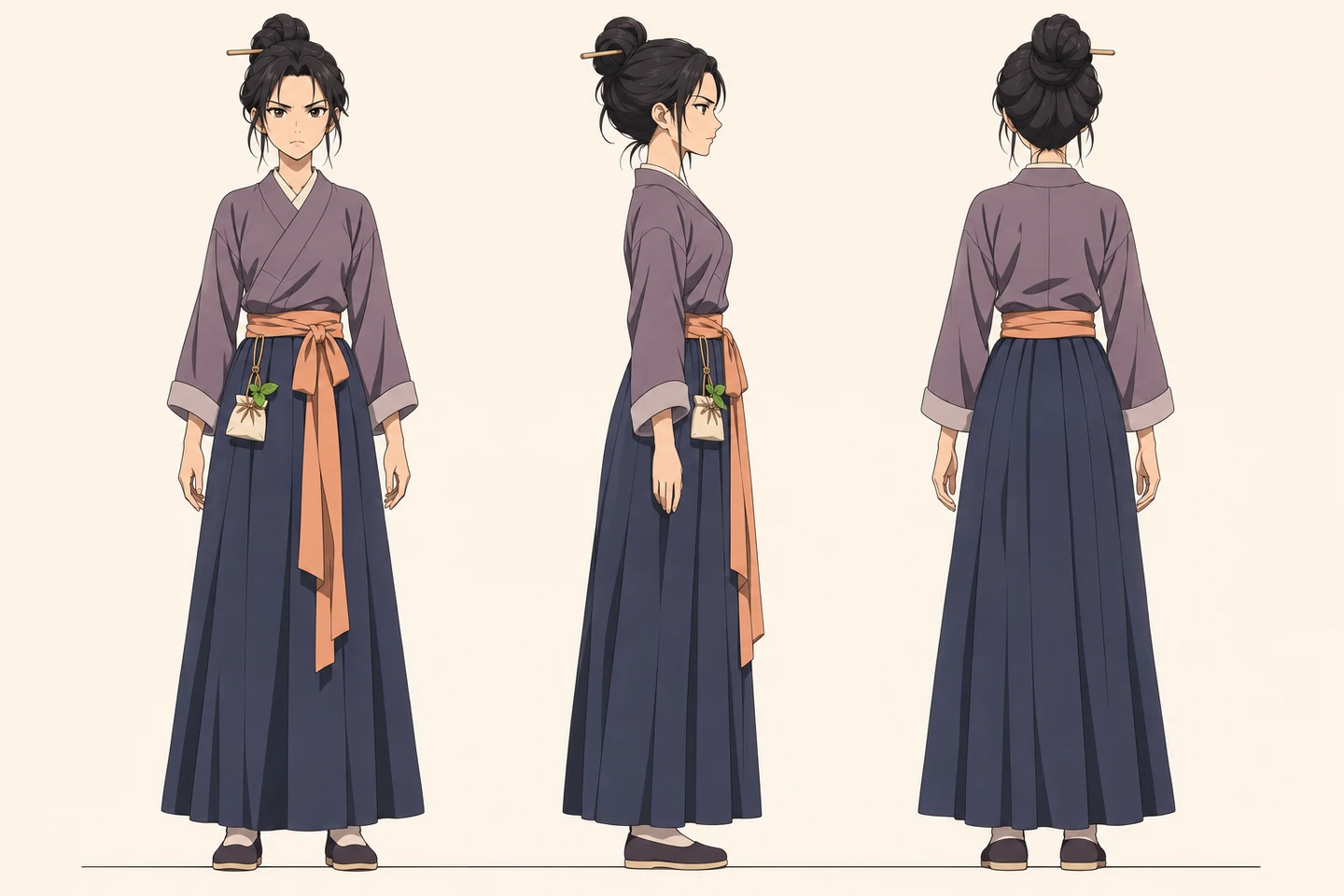
Choose Turnaround for a wide reference showing front, side and back views. Keep Minglan’s pale lilac-gray top, ink-blue skirt, apricot sash, shoes and hairstyle consistent across angles. Specify where a tie, pouch or hairpin sits so each view depicts the same garment and accessories. If you already have an original illustration and your selected model accepts image references, use it to guide identity and palette. For a dedicated sheet workflow, open the character reference sheet maker.

Minglan in three views showing how the ink-blue skirt and apricot sash sit

Front, side and back

Show the moment the routine changes

Scene view gives you space for the setting and the other person in the room. At the consultation table, frame the maid speaking, the two plum-sealed packets with different knots and Minglan’s brush held above the prescription. Bring the packets close enough together for the viewer to compare their cords, and keep both faces in view so the reader can see who has noticed the change. Try the anime character generator for a different visual setting, or return to the OC maker to explore other worlds, including the Gravity Falls OC Maker and Hazbin Hotel OC Maker.

Apothecary Diaries character maker FAQ

Can I make an Apothecary Diaries OC for free?

You can explore the sample designs and edit your own character brief in The Apothecary Diaries OC Maker for free. To generate an image, sign in and check the credit quote for the model you select. The quote appears in the generator before you submit.

Do I need to know the whole story to make one?

The first season gives you enough context to begin. Choose a household or workshop, decide what your character does there and give them one person they regularly deal with. The examples give you starting points for a servant, a physician or a consort, including outfits and props.

Can my OC be a concubine instead of a servant?

Yes. Start with the consort role and give your character a small household, a distinctive garment and something she likes to do away from formal duties. Yanrui paints insects in the garden. The fan, sleeve and quiet corner of a pavilion give you enough to make her first scene.

Can I use Maomao or Jinshi as a base?

Build an original character with their own face, silhouette, outfit and personal history. The apothecary diaries character creator lets you choose a related occupation or familiar setting, such as an apothecary’s workroom or a palace office. For image references, use your own original character art.

What should my OC's job be in the rear palace?

Start with the thing you want to draw your character doing. A linen worker can balance a bundle, a household attendant can deliver a message and a paper inspector can hold a sheet to the light. Choose a task they would repeat and an object they would keep close.

How do I make the outfit look like the show?

Use layered robes, cloth sashes and pinned hair as a starting point, then choose colors, fabric and sleeve shapes that reflect your character’s work. Shorter or tied-back sleeves free up the hands of a craft worker. A formal gown can carry its strongest detail on the lining or cuffs.

Can I turn the design into a full-body reference sheet?

Yes. Choose Turnaround for a prompt that requests head-to-toe front, side and back views. Describe the location of the sash knot, hair ornaments and pouch so those details have a consistent placement across the sheet. A model that accepts image references can use your original illustration as a guide.

Is this official?

This is an independent fan-made character design tool. It is unaffiliated with The Apothecary Diaries and its creators, publishers or production partners. The example characters, trades and dilemmas on this page are original concepts for making fan characters within a setting inspired by the series.

Fan-made. Not affiliated with Hyūganatsu, Shufunotomo or Square Enix.