
What an OC template is (and what it isn't)
An OC template is a blank layout for an original character. It gives drawings and notes a place to go so you can find the details you need later. A turnaround can sit beside a palette, a close-up can explain how a clasp closes, and a bio can record why the character takes a job they dislike.
The layout leaves those creative choices up to you. It works for a human, creature, robot or anything else you can describe or draw. It also leaves out the rules specific to a game system, so add your campaign’s stats separately when you need them.
The worked examples follow Pip Fen (they/them), a 19-year-old marsh mouse who delivers letters at night from the Reedbank ferry huts before the tide turns. Their teal rain cape, brass crescent clasp and red waxed satchel carry through the visual sheets, written bio and public profile.
Blank OC template downloads (PNG + A4 PDF)
Choose the sheet that fits the job in front of you. Each card shows the blank layout and offers the same template as an image for digital editing and a PDF sized for A4 paper. The worked examples further down show what each layout can hold.
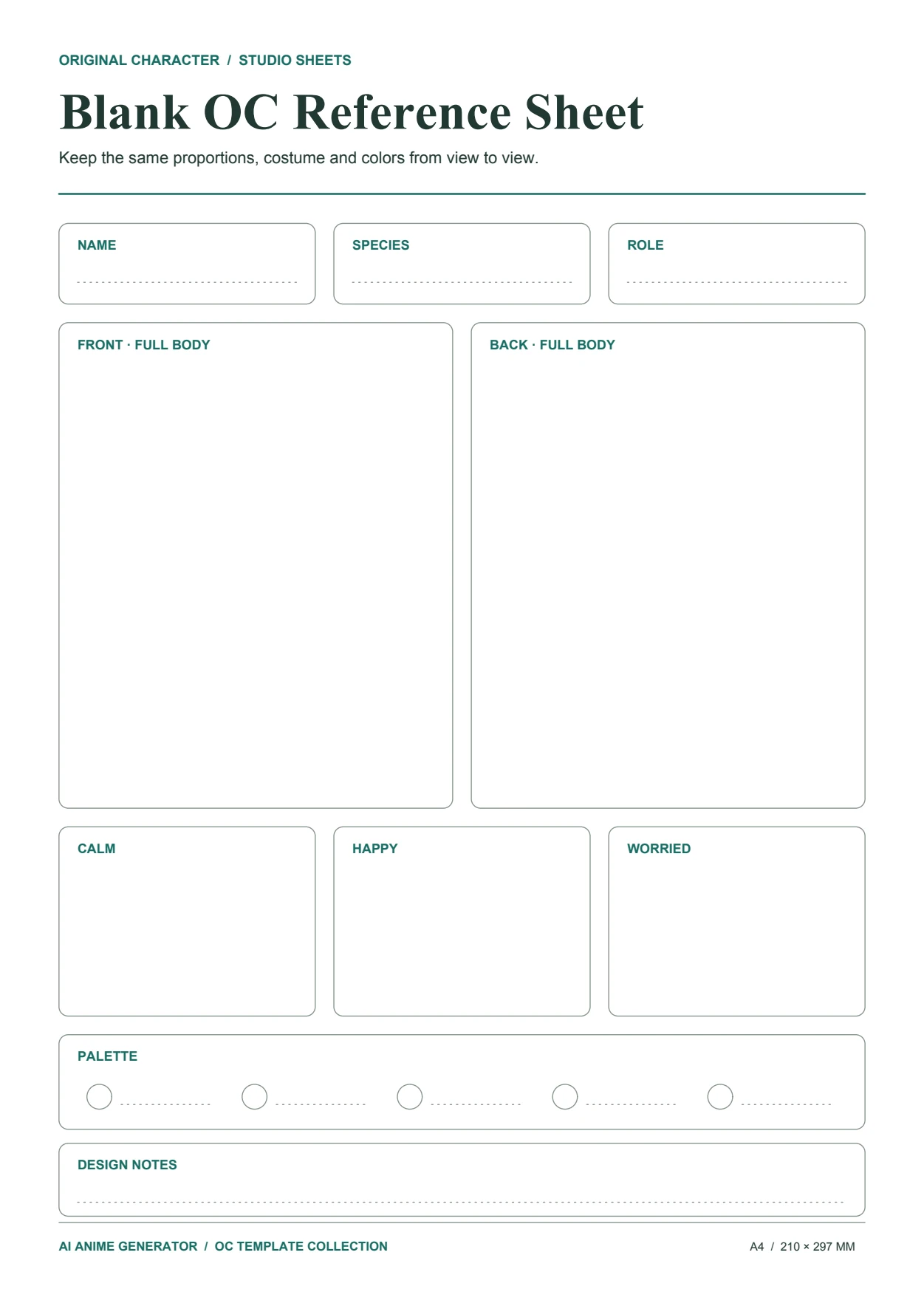
Blank ref sheet – front and back
Front and back views with three expressions for a compact art reference.
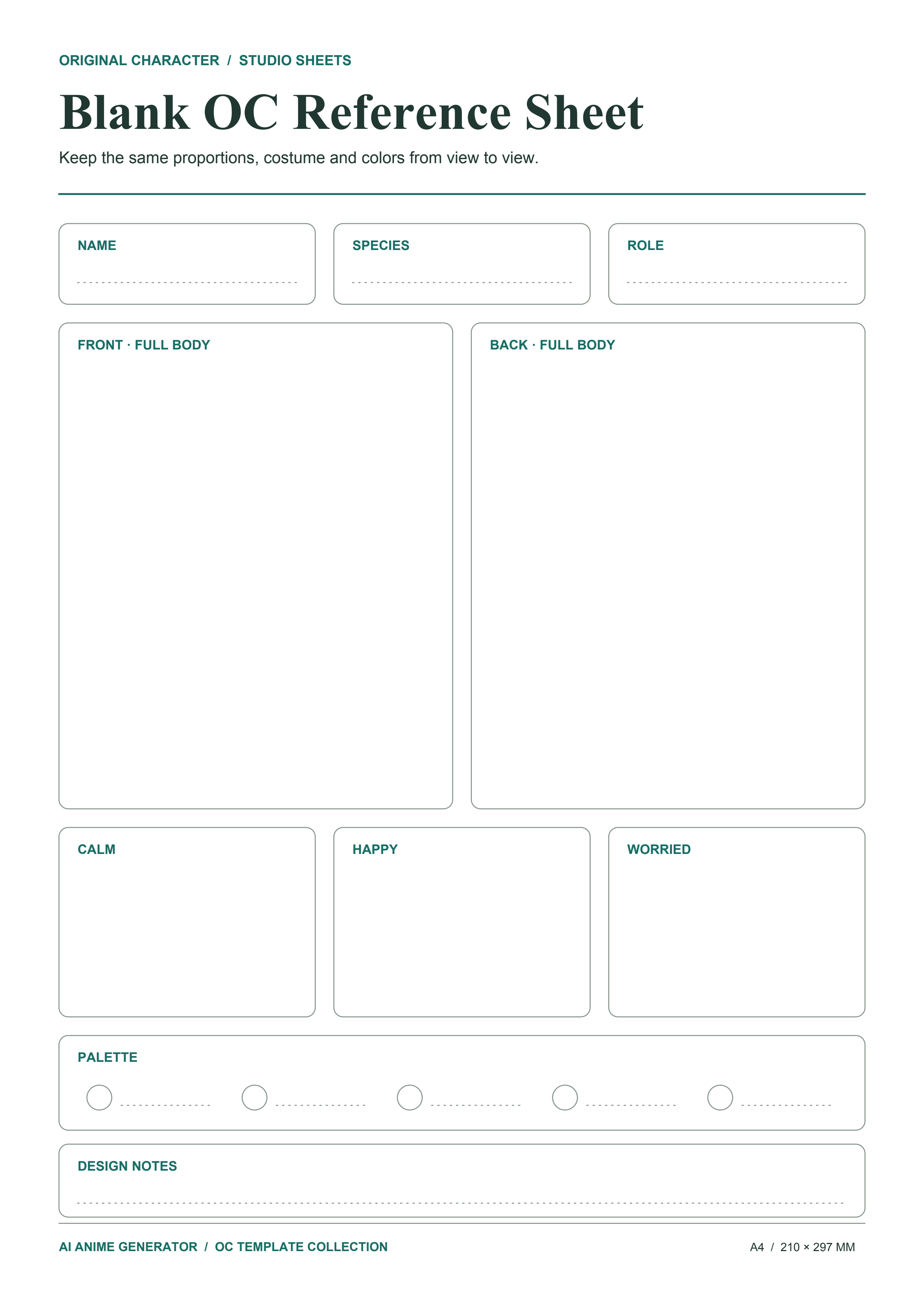
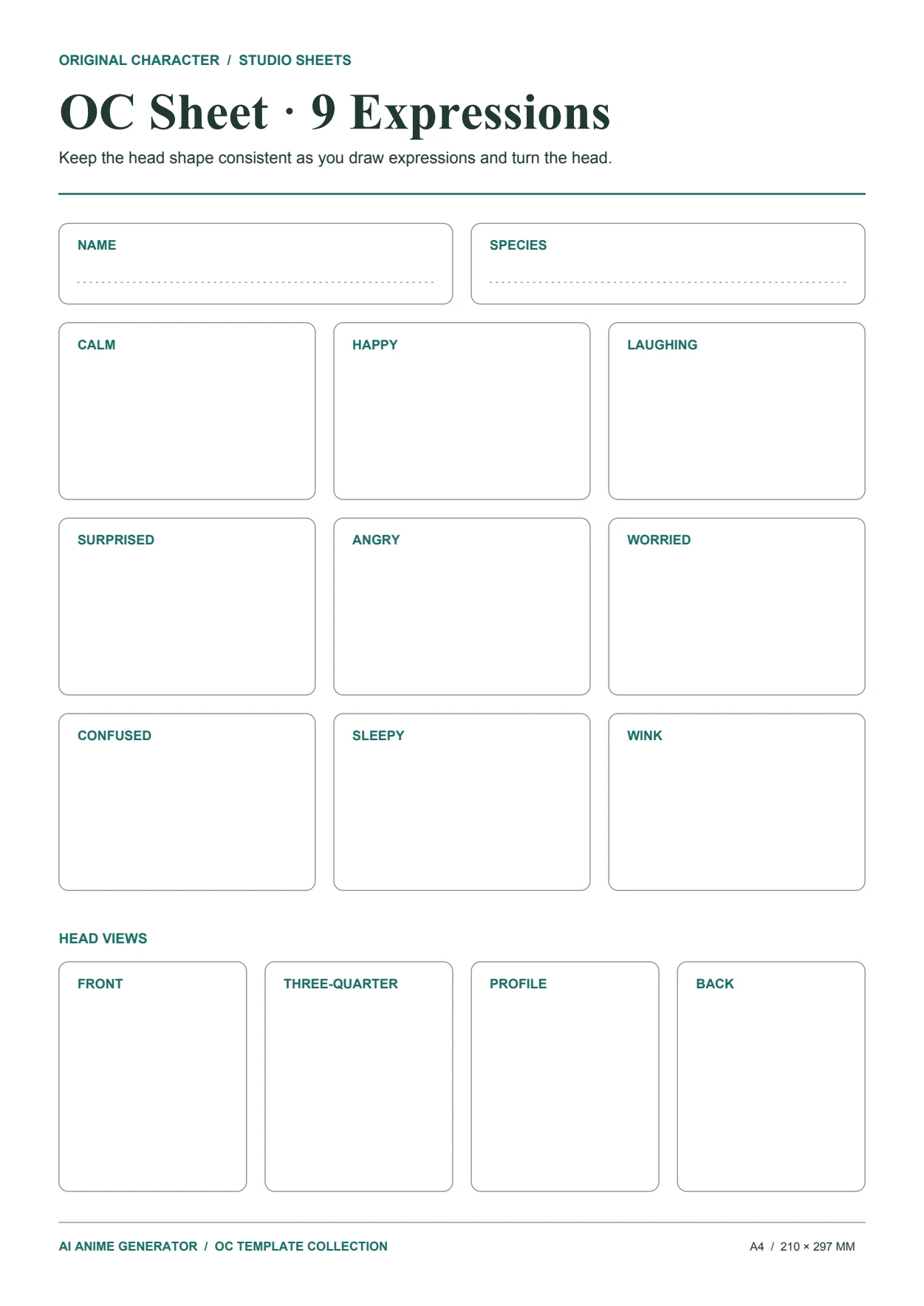
9 expressions + four head views
Four head angles and nine expressions for comics or reaction art.
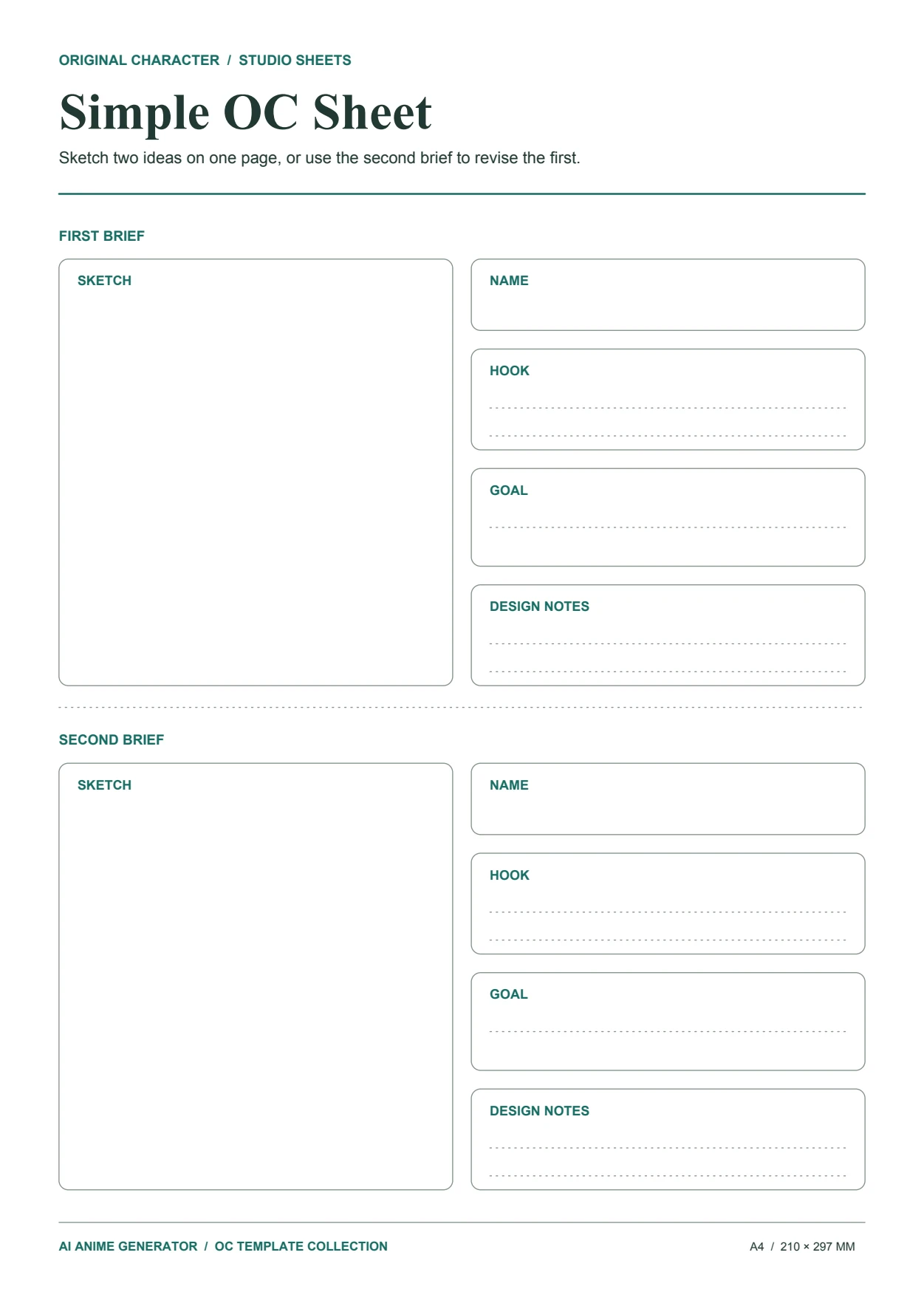
Two half-page character briefs
Sketch two characters on one page, or revise the first draft in the second half.
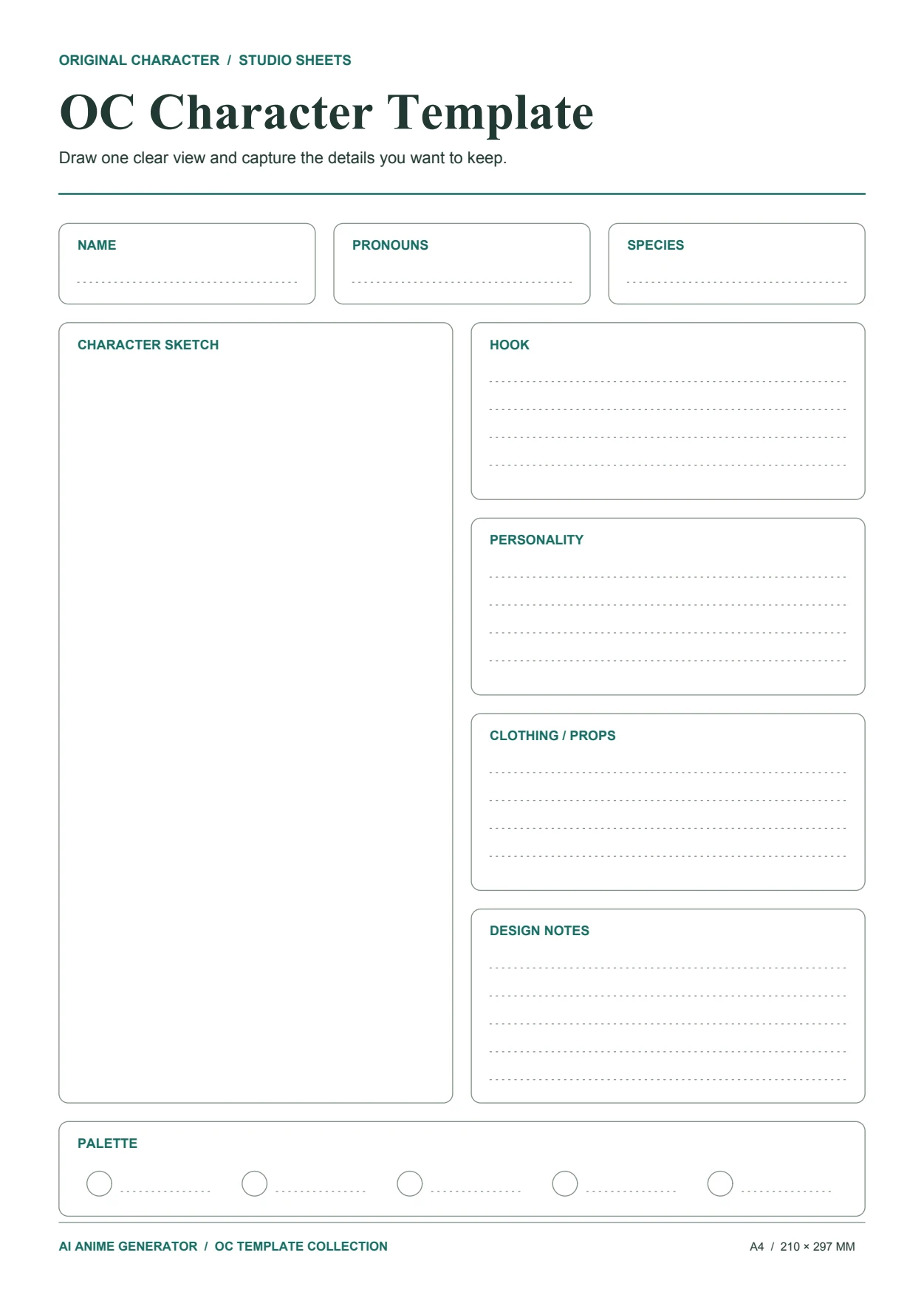
One full-body sketch with design notes
Develop one full-body pose and its outfit details.
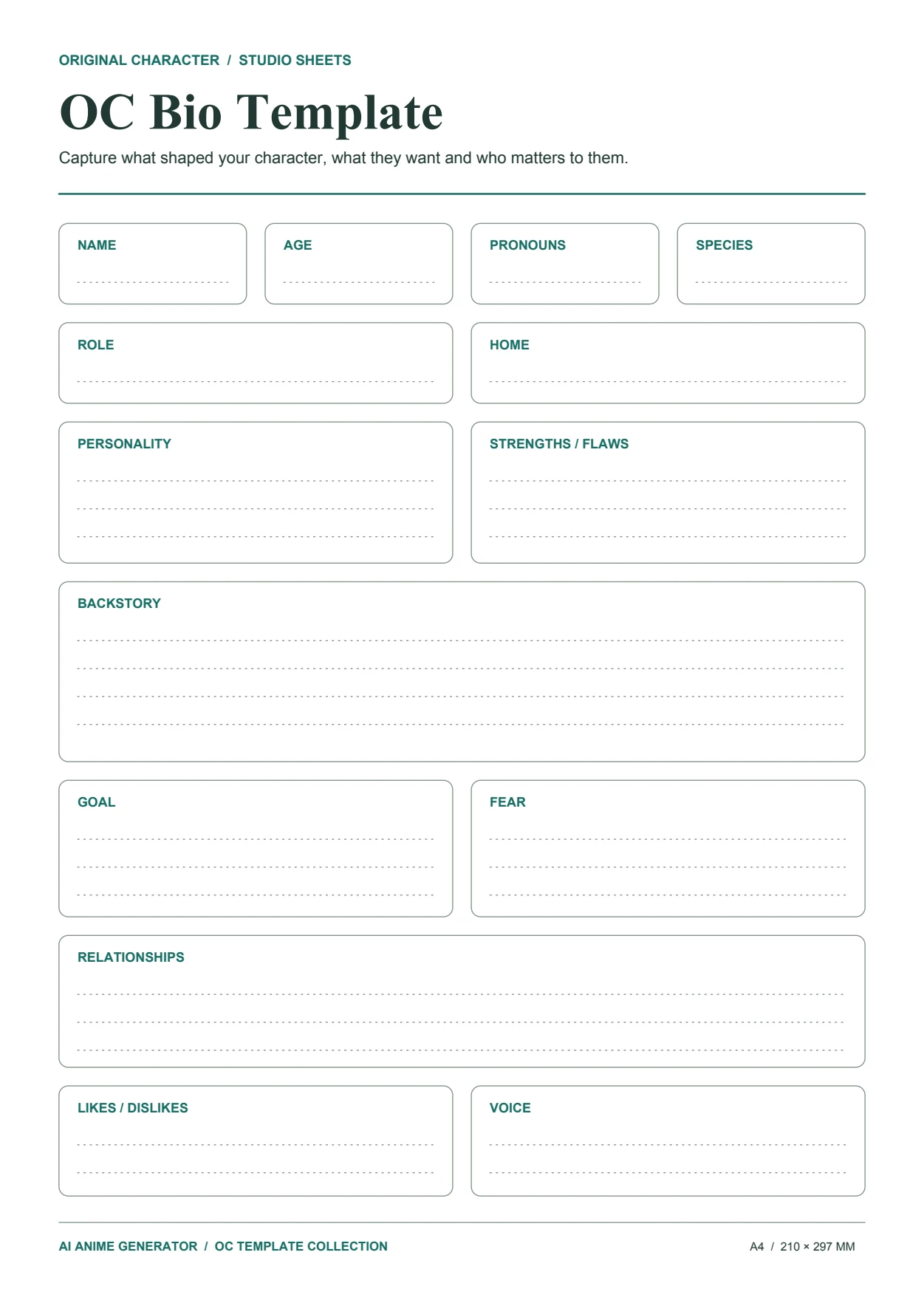
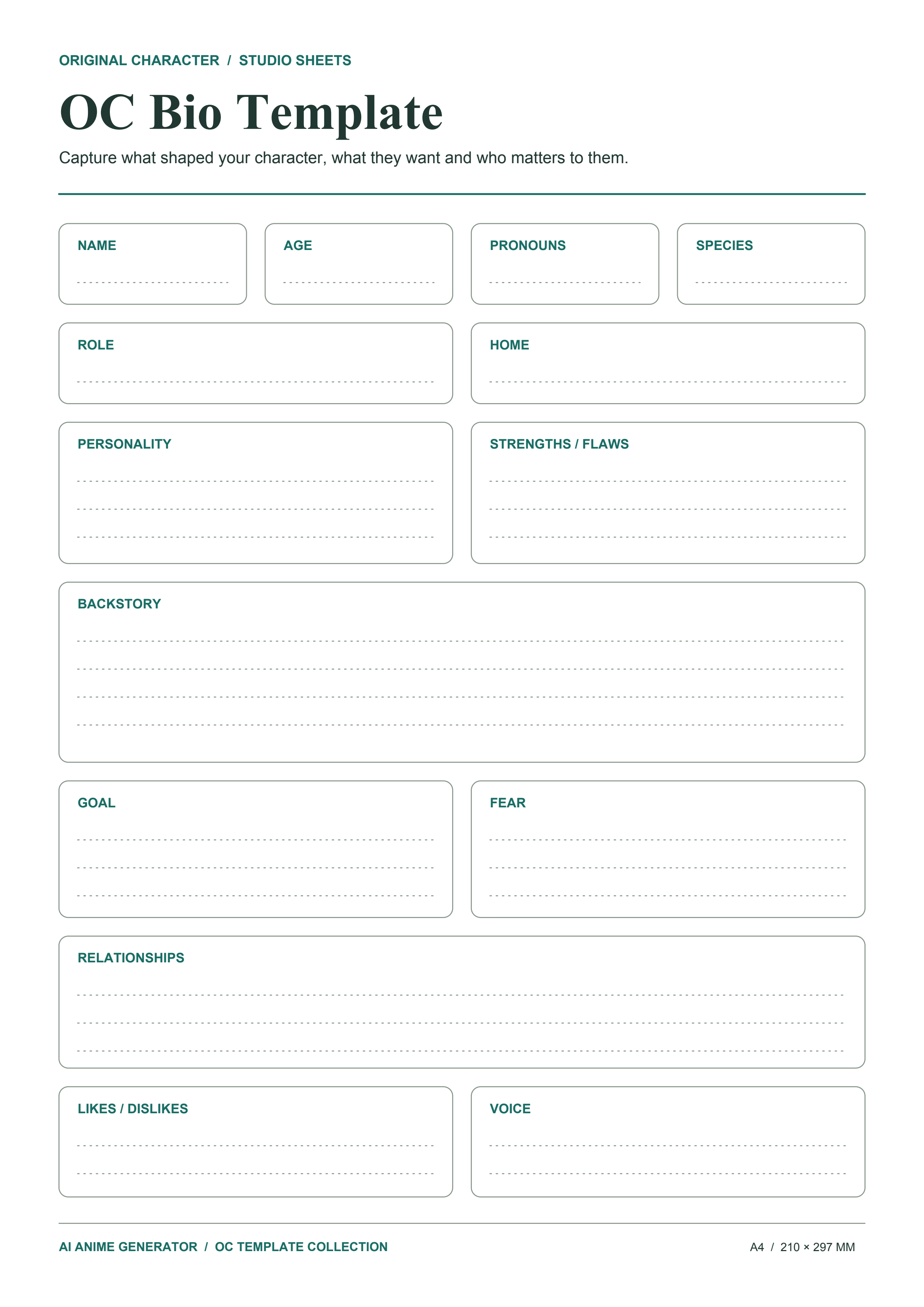
Backstory, goals and relationships
Record motivation, conflict, relationships and backstory.
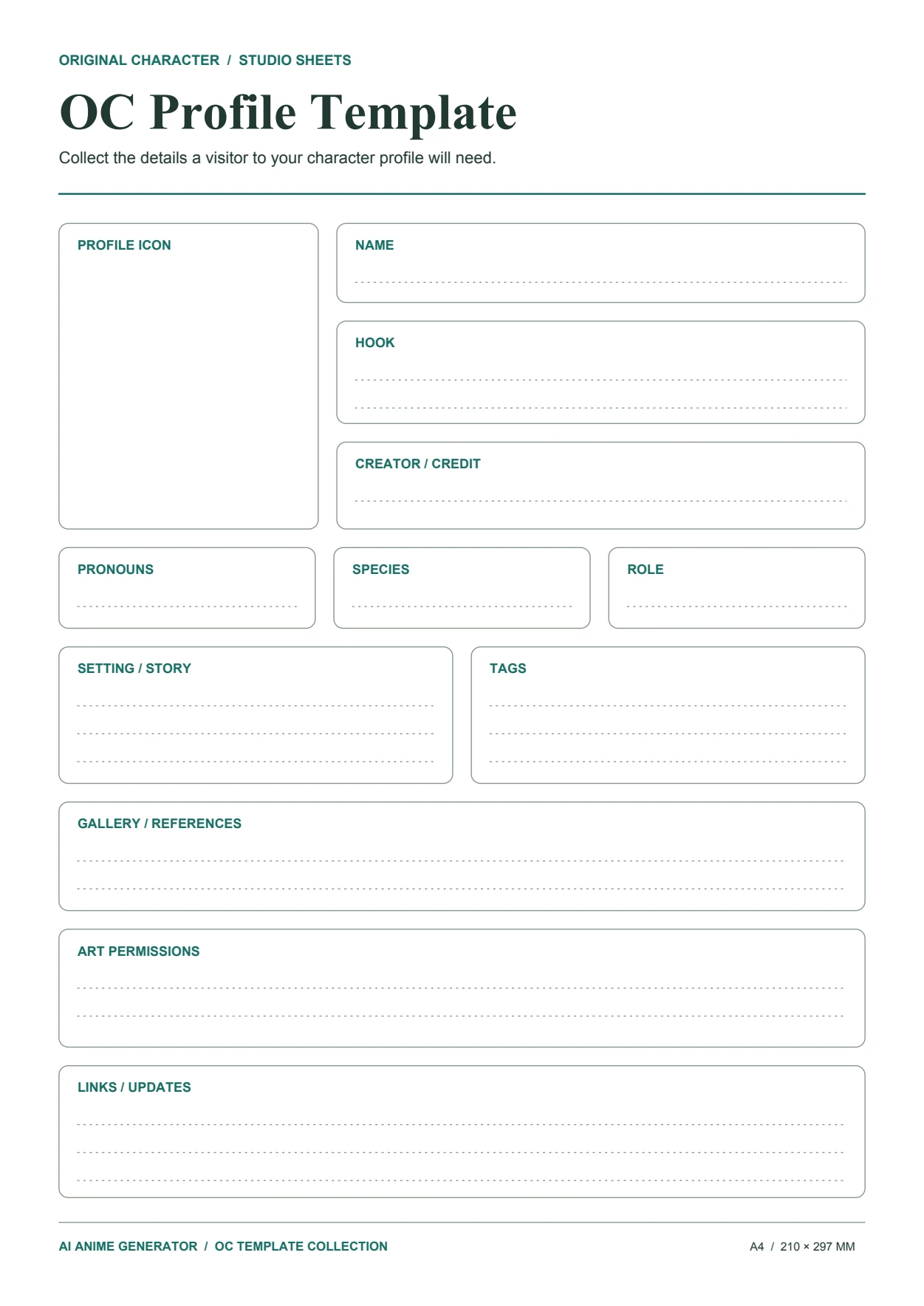
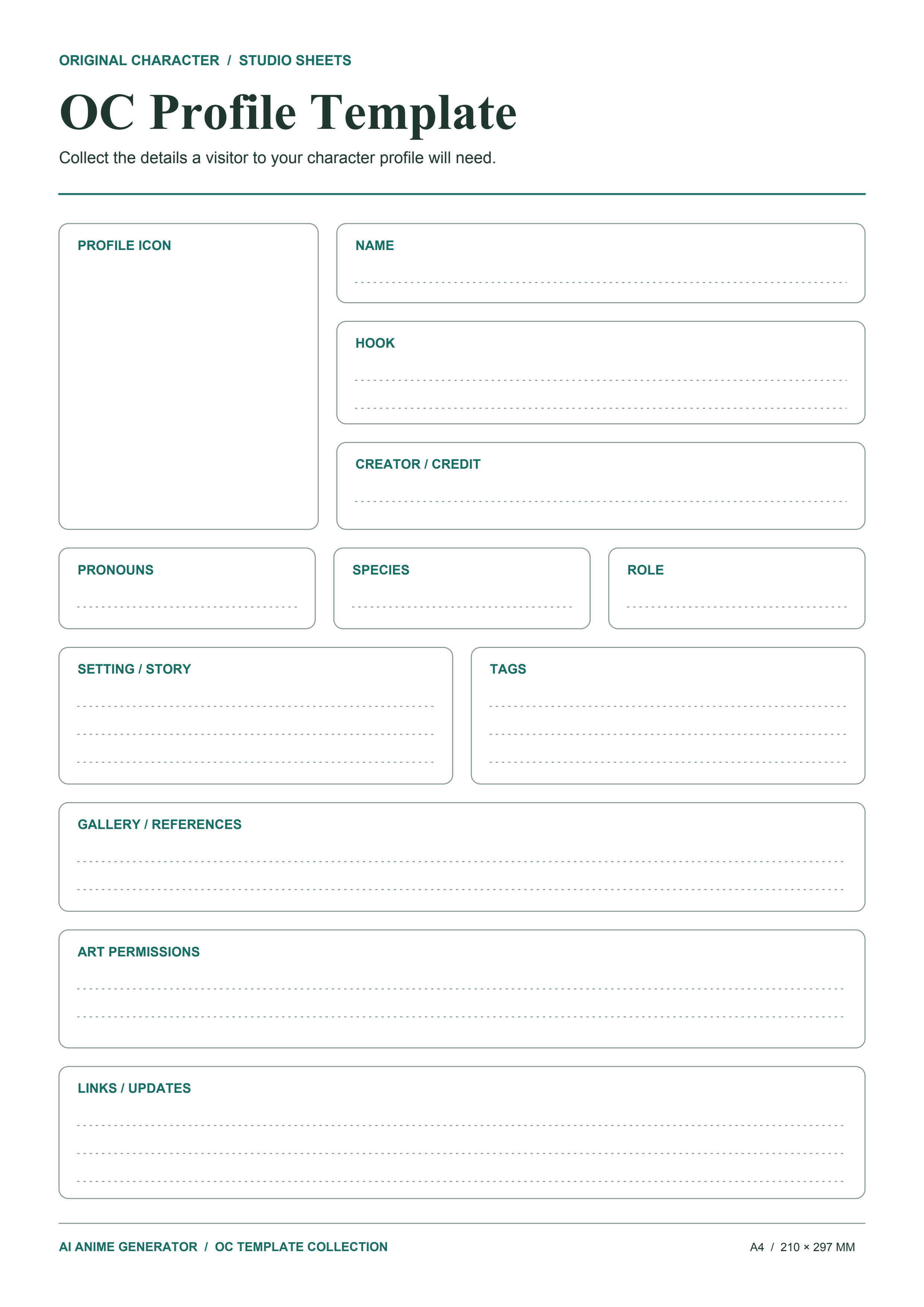
Public profile and art credits
Plan a short public-facing introduction and separate creative credits.
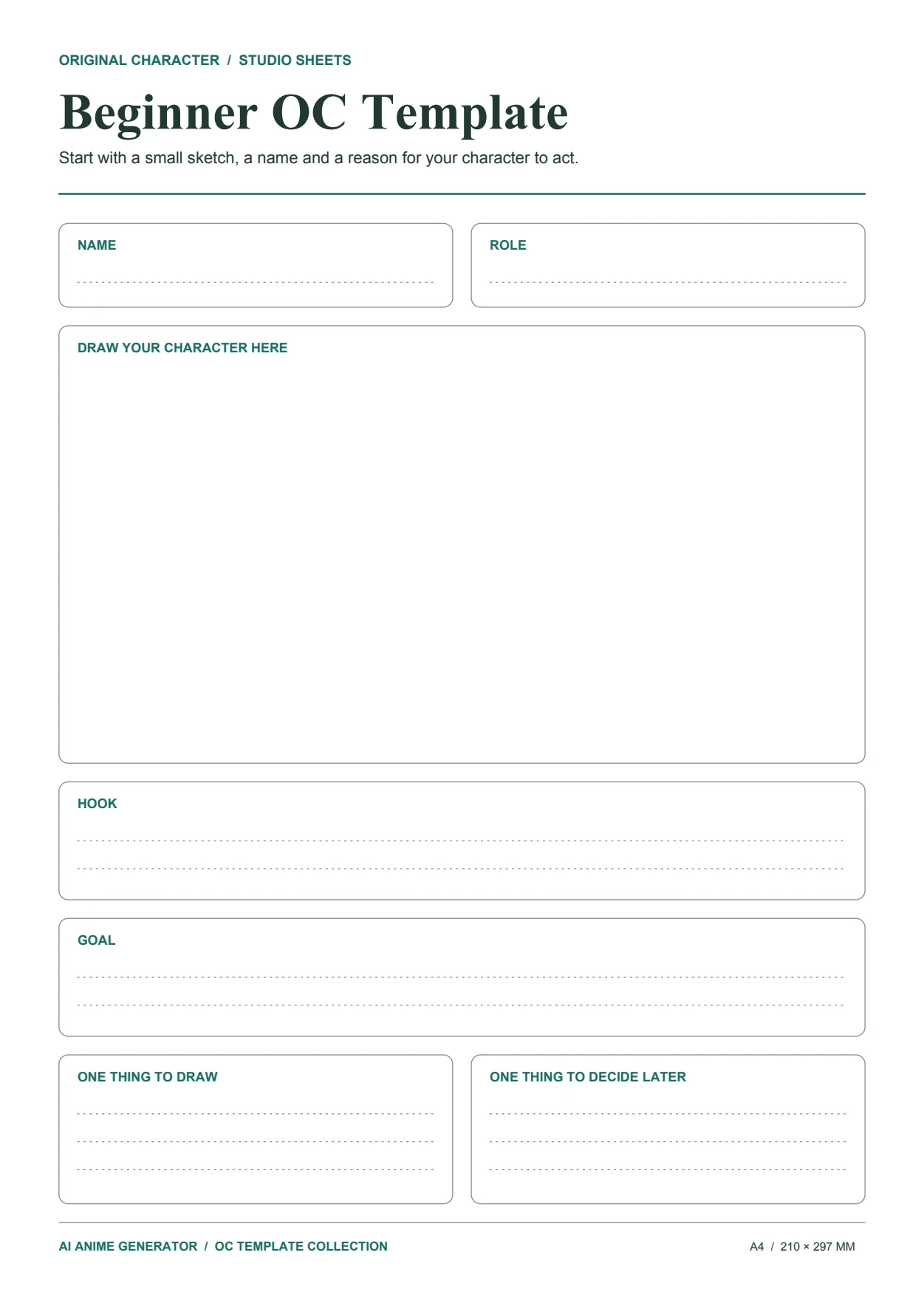
First sketch and story hook
Capture a first face, role and recognizable detail on a single page.
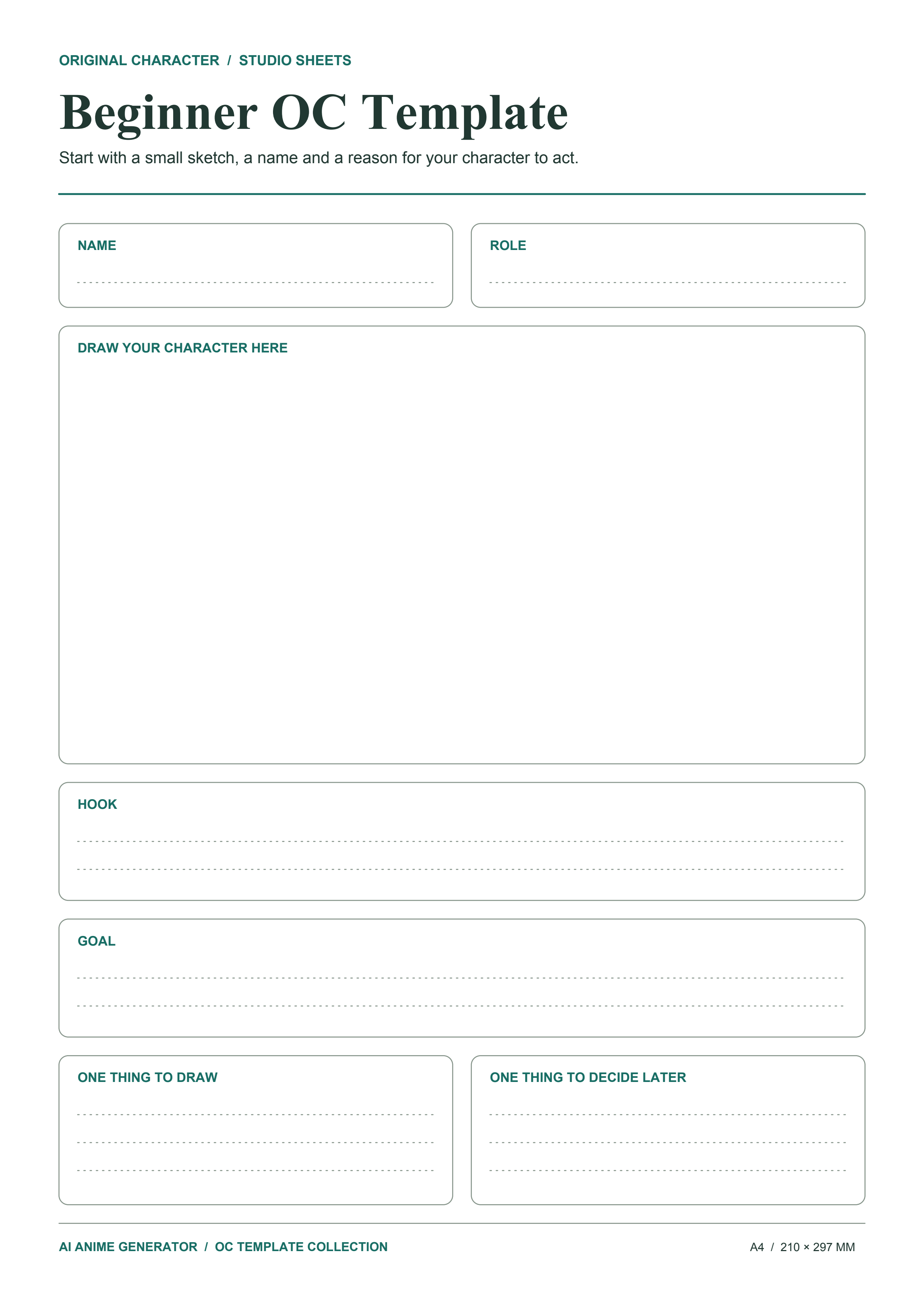
For a print-and-pencil session, use the PDF. For digital work, open the PNG as a background layer, lock it, and put text and artwork on new layers. Keep an editable copy separately so you can swap the art or update a note without reconstructing the page.
OC reference sheet template
Use the reference sheet when someone needs to draw your character from more than one angle. Start with a neutral stance and keep the front and back at the same scale. Align the top of the head and the soles of the boots. A straight-on view establishes width, and a back view resolves details the front hides. Use the three expression spaces to show how that same face changes when the situation changes.
Give small details their own space. For Pip, the clasp belongs at the collar and the satchel strap crosses the cape. A small close-up can show where the clasp meets the fabric. Draw the bag separately if the cape hides it, and label any detail that belongs to a particular side.
Use the palette for colors you want another person to repeat. Label swatches by material or garment. Teal cape and red satchel are more useful labels than a sequence of anonymous colors. Add a short note for any feature that can vary, such as whether the hood sits up or down.
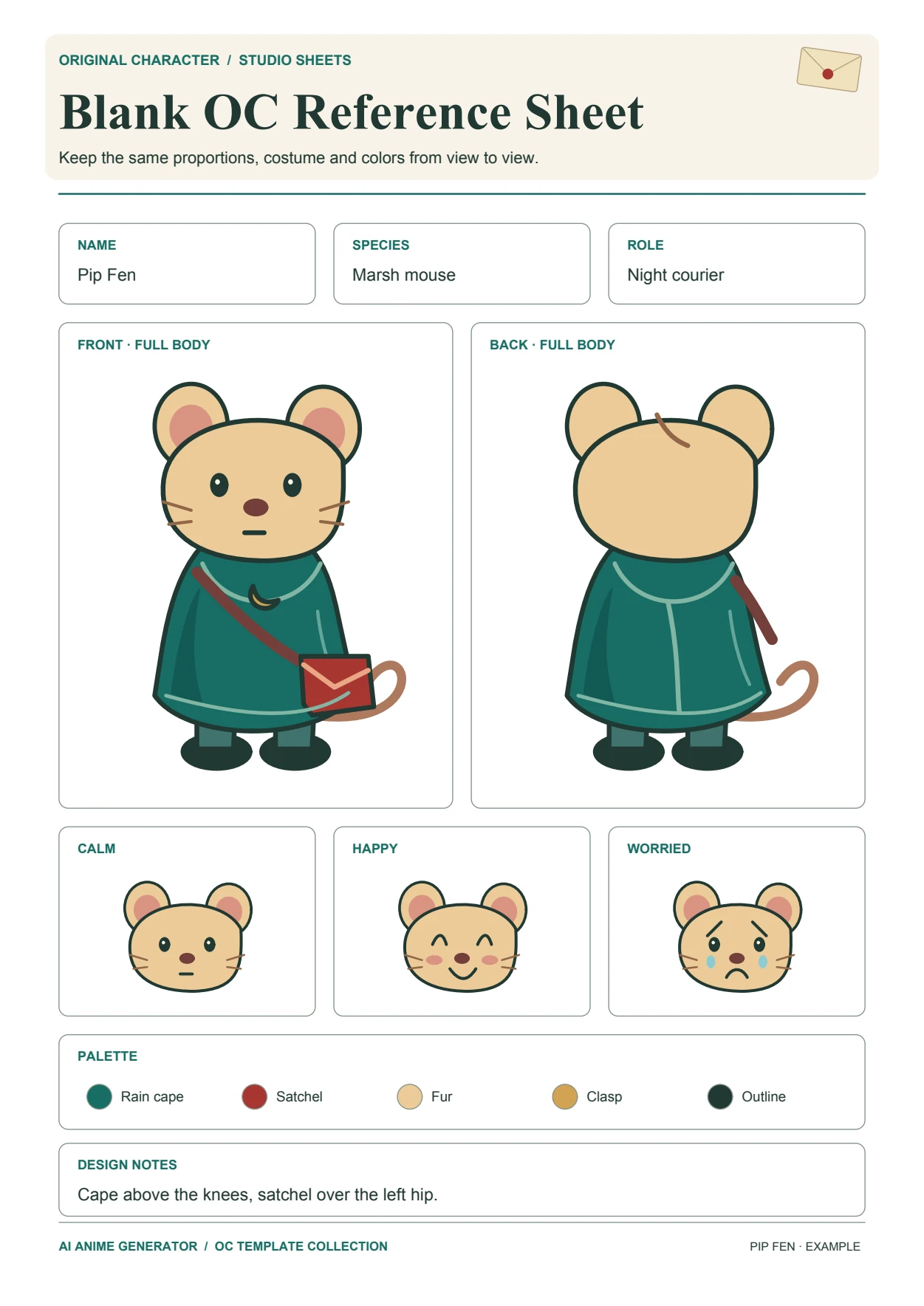
Prompt for this example
Pip Fen is a 19-year-old marsh mouse who delivers letters at night between the Reedbank ferry huts before the tide turns. They wear a teal rain cape fastened with a brass crescent clasp and carry a red waxed satchel. Draw matching full-body front and back views, three small studies of Pip looking alert, amused, and worried, and palette swatches for teal, red, brass, and warm brown. Keep the cape hem and satchel strap consistent.Use this prompt in OC Maker
OC sheet template & character sheet template: what goes in each block
A character sheet is useful when you want the design and the story premise in one place. Put the everyday outfit in the main image, then use the smaller blocks to record whichever facts a friend would need to recognize or write the character. A recurring prop and a clear role carry more weight than a long list of favorite things.
- Main artwork
- Draw Pip standing with the satchel visible. Leave enough room to see the shape of the cape and boots.
- Identity
- Write the name and job. Add a setting or group only when it explains something about the design.
- Design notes
- Pick a few repeatable details. Call out the crescent clasp and the worn strap before listing optional costume variations.
- Colors and gear
- Show the dominant colors and one object the character uses. A weatherproof letter bundle makes sense for a marsh courier.
If you already have a main drawing and need more angles, the Character Reference Sheet Maker uses it as a starting reference.
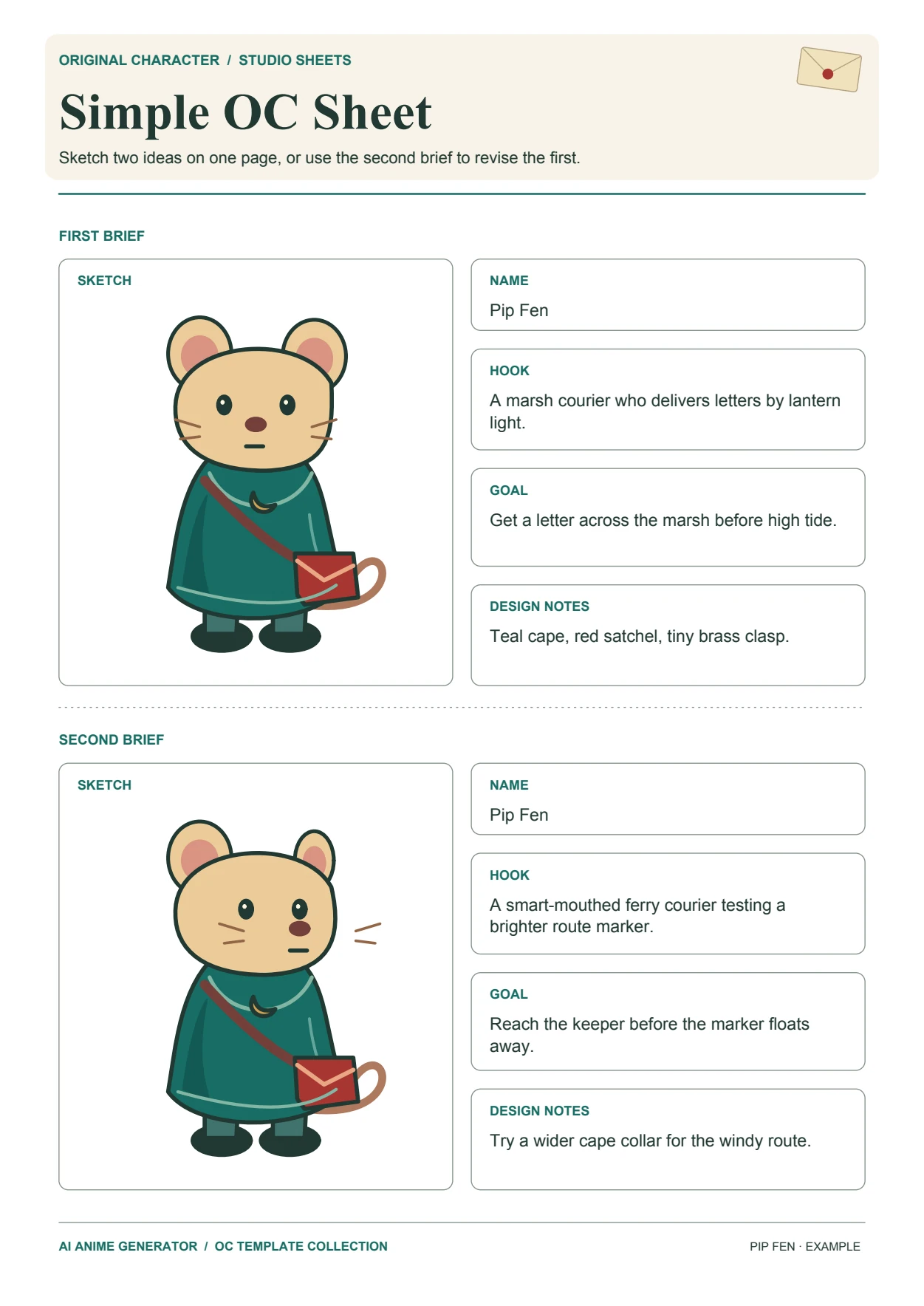
Prompt for this example
Pip Fen is a 19-year-old marsh mouse who delivers letters at night between the Reedbank ferry huts before the tide turns. They wear a teal rain cape fastened with a brass crescent clasp and carry a red waxed satchel. Draw a single standing figure against plain cream. Make the cape silhouette clear and use a small teal, red, brass, and warm brown palette beside the character.Use this prompt in OC Maker
OC character template: 9 expressions + turnaround
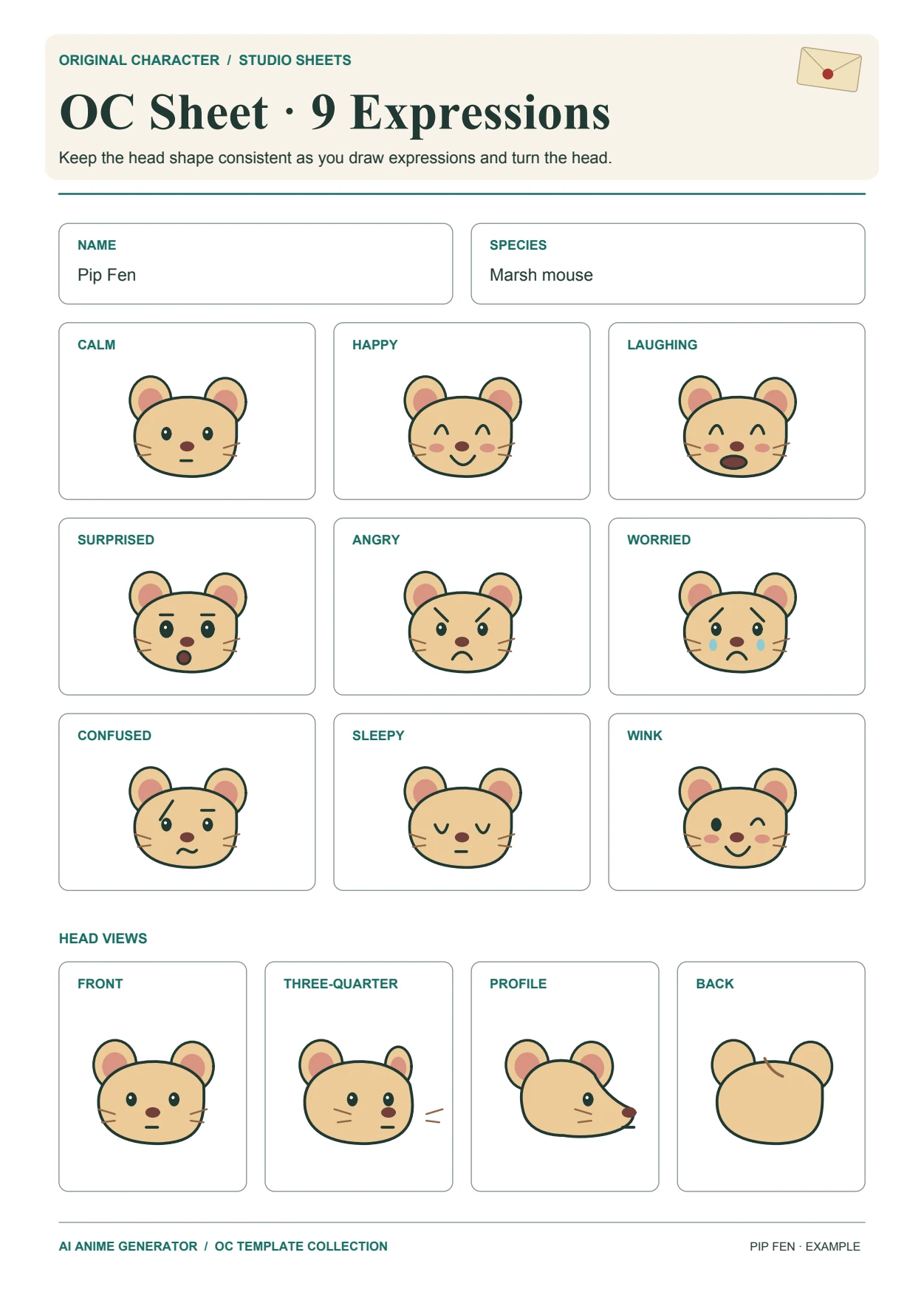
The expression grid is for learning what the same face does in different moments. Draw neutral first, then use it to keep the jaw, hairline and distance between the eyes steady. Try happy, laughing, surprised, angry, worried, confused, sleepy and winking around that neutral anchor. Change the eyebrows, eyelids and mouth independently so each reaction reads at thumbnail size.
Use a similar viewing angle and scale across the nine boxes. For a comic, pick reactions the character actually uses. Pip’s alarm at a broken footbridge might read as a tight mouth and wide eyes, while relief at spotting a dock could show in softer brows and a barely open smile.
Prompt for this example
Pip Fen is a 19-year-old marsh mouse who delivers letters at night between the Reedbank ferry huts before the tide turns. They wear a teal rain cape fastened with a brass crescent clasp and carry a red waxed satchel. Make nine head-and-shoulder studies with the same face, hairstyle and clasp placement. Explore neutral, pleased, amused, surprised, worried, angry, embarrassed, exhausted, and determined. Add a four-angle turnaround showing the same character from the front, three-quarter view, side, and back.Use this prompt in OC Maker
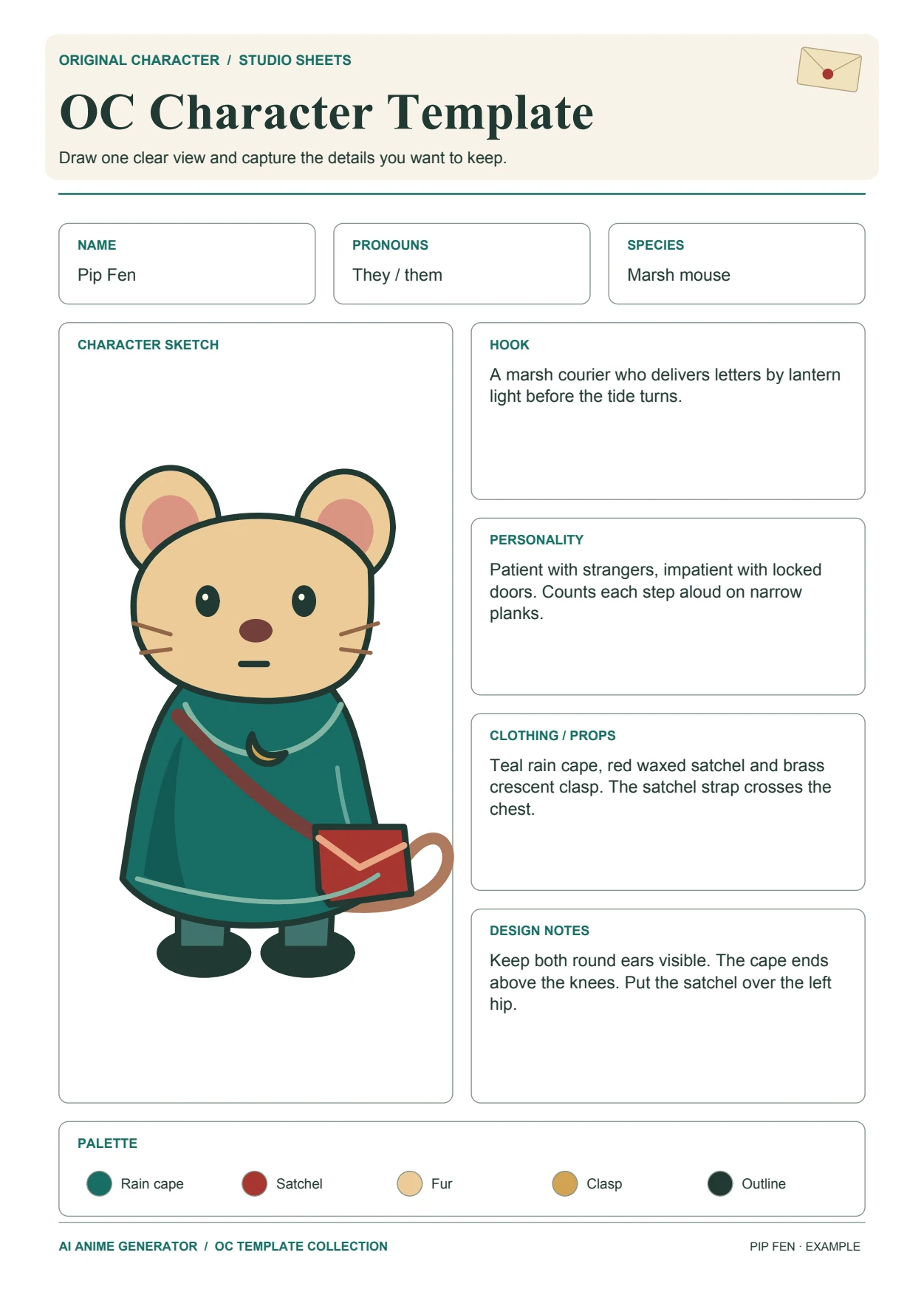
Switch to the single-view OC character template when one pose needs room to read. A neutral full-body stance can show the outfit, or you can choose an action that explains the role. Pip can stand ready to cross a flooded boardwalk, with a route map in one hand and the satchel visible at the hip.
Prompt for this example
Pip Fen is a 19-year-old marsh mouse who delivers letters at night between the Reedbank ferry huts before the tide turns. They wear a teal rain cape fastened with a brass crescent clasp and carry a red waxed satchel. Draw one full-body character ready to cross a flooded boardwalk. Show the cape over a practical layered outfit and the courier holding a folded route map in a gloved hand.Use this prompt in OC Maker
OC bio template: the written half
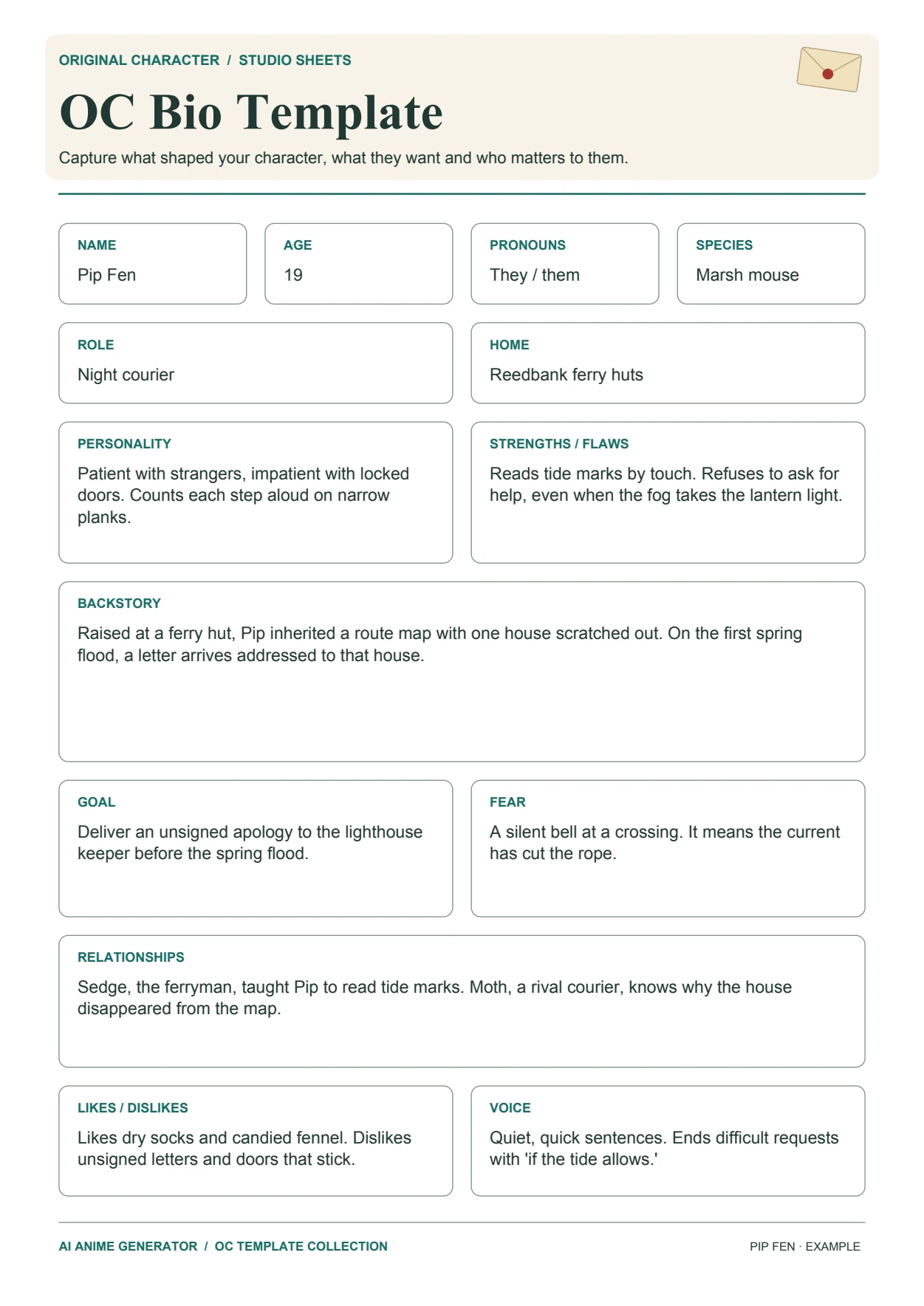
The bio sheet holds the decisions a drawing cannot show on its own. Start with what the character wants, what makes that hard and how they respond when things go wrong. Those three answers give you actions to write. Leave the detailed timeline for later if the story is still taking shape.
For Pip, the first line could be “A Reedbank courier trying to deliver the last letters before the tide turns.” A flooded crossing gives the job an obstacle. A boat mechanic who expects a favor in return gives Pip someone to argue with. Together the job, obstacle and relationship suggest a scene you can actually write.
Keep alternate versions or spoilers in a separate note. Update the bio when a new event changes what the character is trying to do. That gives you a quick reference when you return to the story much later.
Need to find the details that belong in the bio? Try these OC questions to answer first.
Prompt for this example
Pip Fen is a 19-year-old marsh mouse who delivers letters at night between the Reedbank ferry huts before the tide turns. They wear a teal rain cape fastened with a brass crescent clasp and carry a red waxed satchel. Pip remembers every doorstep but dreads ferry crossings. Draw the moment before a difficult delivery, with one hand clutching the satchel strap as fog rolls over the ferry landing.Use this prompt in OC Maker
OC profile template: for character hubs and Toyhouse
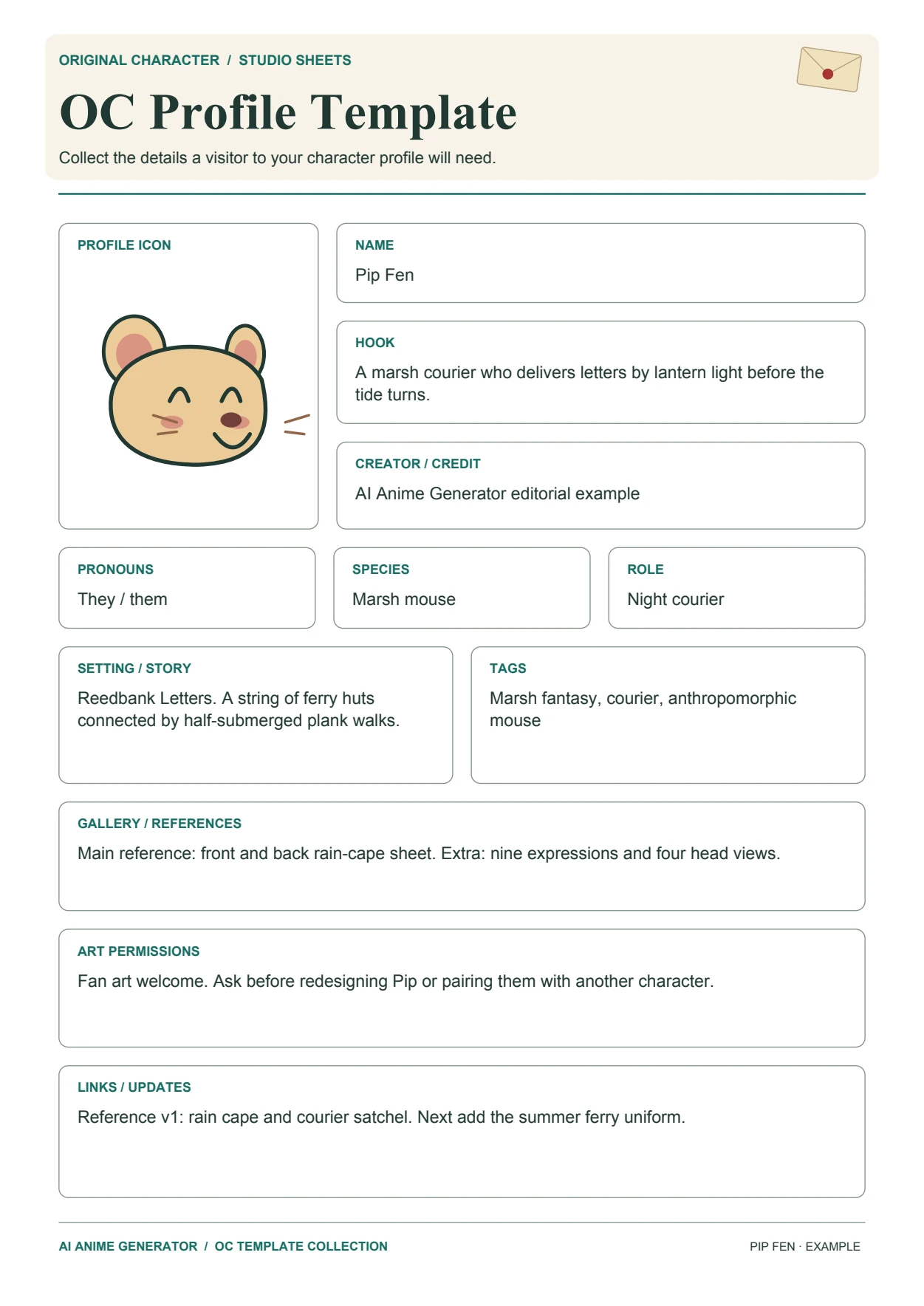
A profile is the introduction another person sees on a character hub or Toyhouse. Put the display name, role and short description near the top. Choose a portrait that still reads when small, then add a few details that tell readers what kind of story or setting the character belongs to.
In a public Pip profile, “Marsh mouse courier with a red waxed satchel and a habit of racing the tide” gives visitors something memorable. Save private backstory for a writing document. Record who made the design and each piece of art, and write your preferences for fan art or roleplay in plain language if you share them.
Prompt for this example
Pip Fen is a 19-year-old marsh mouse who delivers letters at night between the Reedbank ferry huts before the tide turns. They wear a teal rain cape fastened with a brass crescent clasp and carry a red waxed satchel. Draw a chest-up profile portrait with an alert glance and a small, crooked smile. Keep the crescent clasp and red satchel strap visible against a quiet pale background.Use this prompt in OC Maker
Free blank OC template for beginners (one-page)
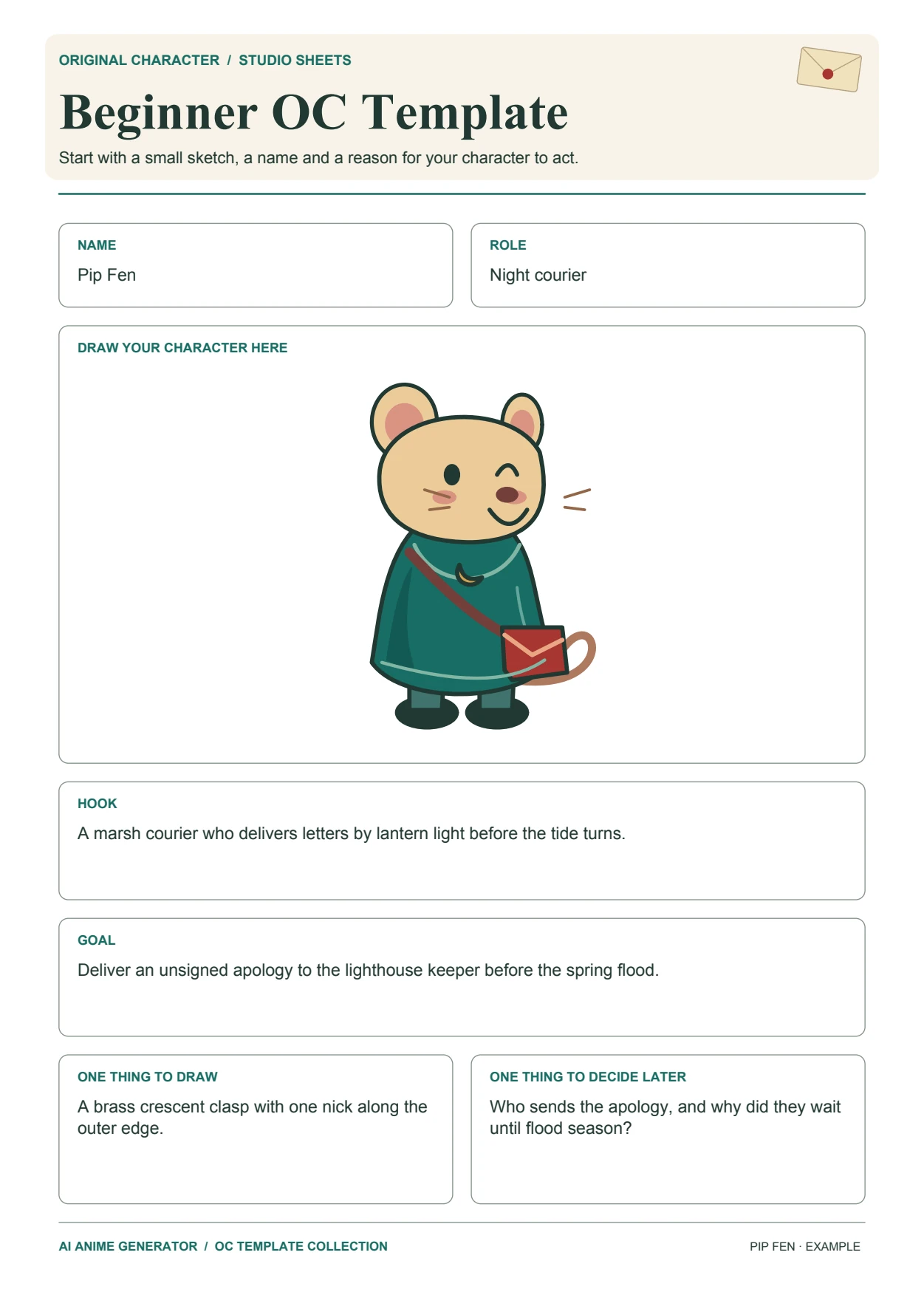
Use the one-page sheet when you have a character idea and very little else. Sketch a face or silhouette, name the role and pick one item someone could recognize from across the room. Pip could begin as a figure in a teal cape carrying a red bag. A simple shape tells you what to explore before you draw the fastenings.
Give yourself one decision to take into the next draft. It could be choosing the shape of the clasp or deciding why the courier works after dark. Add pages later if a story or collaboration calls for more detail. A small sheet that gets used can be enough for a side character.
Prompt for this example
Pip Fen is a 19-year-old marsh mouse who delivers letters at night between the Reedbank ferry huts before the tide turns. They wear a teal rain cape fastened with a brass crescent clasp and carry a red waxed satchel. Draw Pip in a relaxed full-body pose with a shy smile. Focus on the short cape, bright bag, and crescent clasp, with both feet visible against a clean background.Use this prompt in OC Maker
Fill it in on paper, or let AI draw it
On paper, print the PDF and sketch in light pencil. Mark the character’s height in the first drawing so you can keep the same scale in later views. Write short notes while you work, then make a clean copy if you need to share it. Photograph or scan the page flat so the edges stay legible.
For digital drawing, use the PNG on the bottom layer. Keep one group for text, one for art and one for swatches or callouts. Leave a little breathing room around notes so they remain readable once the sheet is viewed on a phone.
To generate art, describe the role, silhouette, clothing and must-keep prop with the OC Maker. Save an image you want to build around. For additional angles, bring that art into the Character Reference Sheet Maker, then compare the views and place the ones you want into the blank layout. The download remains useful even if you only generate the first portrait and draw the rest yourself.
Character reference sheet vs OC template: which do you need?
Choose a character reference sheet when the person using it needs to match the design, as in an art commission, animation handoff or a comic with several artists. Give them visual answers first. Show what the back of the cape looks like, where the bag hangs and which details they’re free to change.
Choose a broader OC template when you need to plan the character or introduce them to readers. A bio answers what the character wants. A profile answers what a visitor needs to know. A simple character sheet combines just enough of both worlds. You can keep the bio private while sharing the reference sheet with a collaborator.
FAQ
Can I use these OC templates commercially?
For a commercial project, use character art and text you own or have permission to publish. Check any commission terms that apply to the material you add. Downloading the blank layout does not establish a license to resell or redistribute the layout, or to use material owned by someone else.
How do I print a blank OC template?
Choose the A4 PDF, load A4 paper and print at actual size (100%) if you want to preserve its scale. If your printer clips the edge, use Fit to printable area. On US Letter paper, choose Fit and check that the preview shows all borders before printing.
Do I need to sign in to download the PNG or PDF?
No. The blank PNG and PDF files download directly. If you decide to create new art with the linked generators, sign-in and generation credits are separate from the downloads. Review the credit amount shown for the selected model before you generate.
Can I use the OC profile template for Toyhouse?
Yes. Draft your summary, creation credits and any permissions on the profile sheet, then transfer the text and art into the fields available on your Toyhouse profile. The download gives you a layout to plan with.
Can AI turn my template into a finished character sheet?
AI can help generate the portraits and views you put in the sheet. Generate art with the character description, then place your chosen images into the layout and type the notes yourself. Review outfit details across views before you share it.
Make your next original character
Pick the smallest sheet that answers your next question. Start a new character from a role and one signature object, or take an existing drawing and build the extra views you need.